gazetteer

Vancouver stamp

Stamped by Time and Place: Geography and Postmarks

Last year I wrote about my stamp collecting hobby in a piece that explored maps and geography on stamps. Since it was well received, I thought I’d do a follow-up about geography and postmarks on stamps. I also thought it would be a good time to feature some “lighter” content.

Many collectors search for lightly canceled stamps to add to their collections, where the postmark isn’t damaging, heavy, or intrusive to the point that it obscures what’s depicted on the stamp, while others will only collect mint stamps. But the postmark can be interesting, as it reveals the time and place where the stamp did its job, and may also convey additional, distinct messages that tie it to the location where it began its journey.

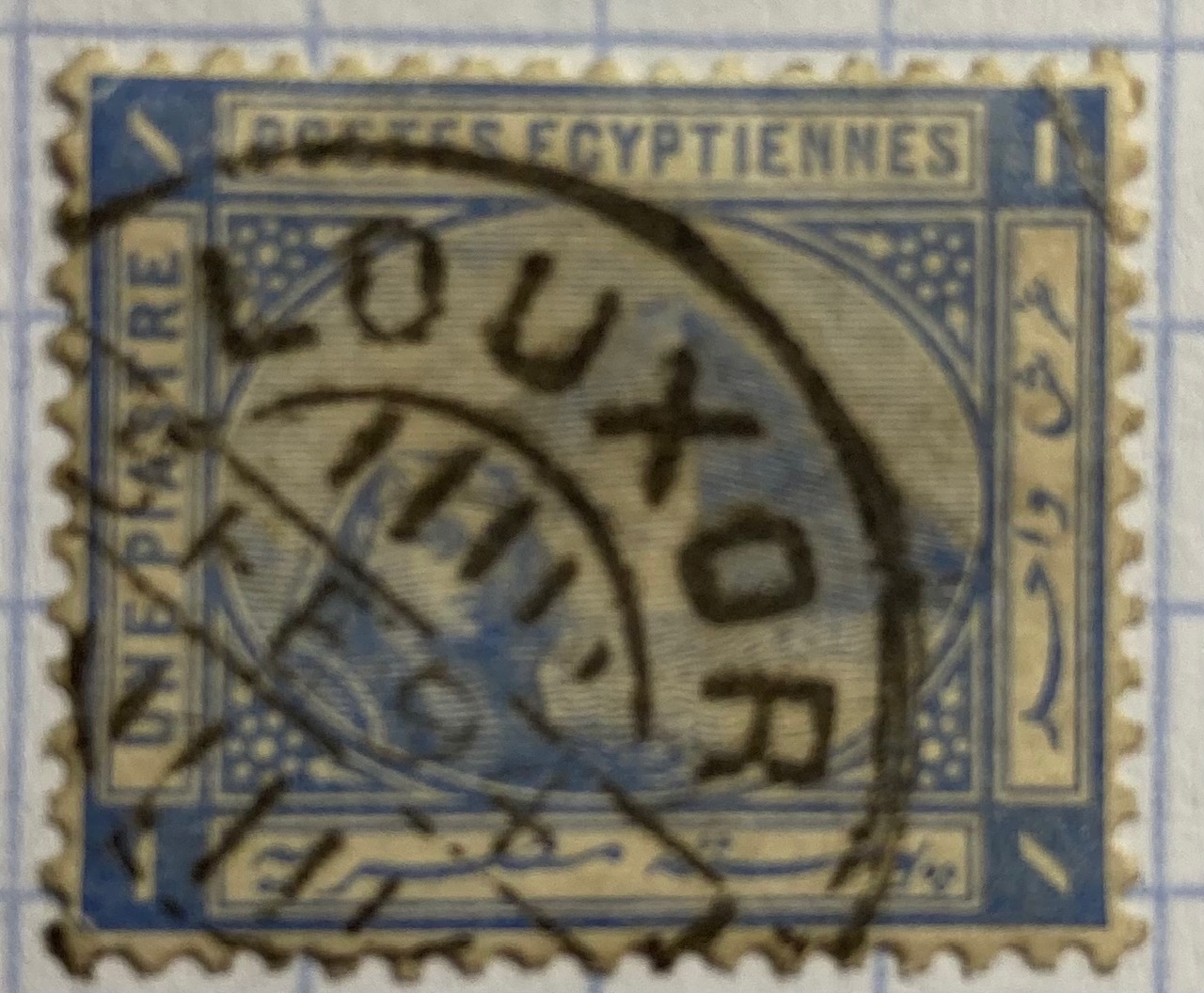
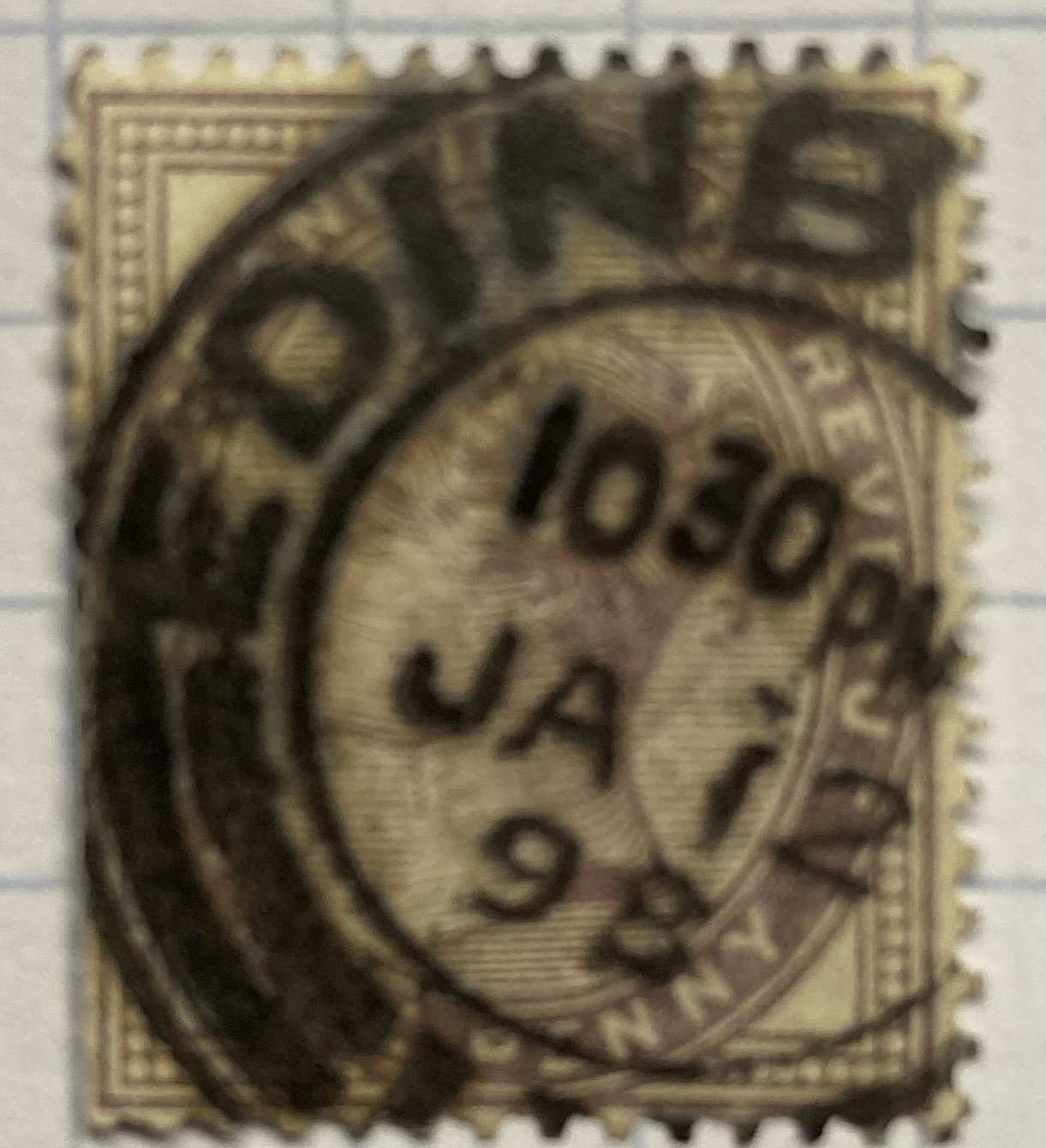
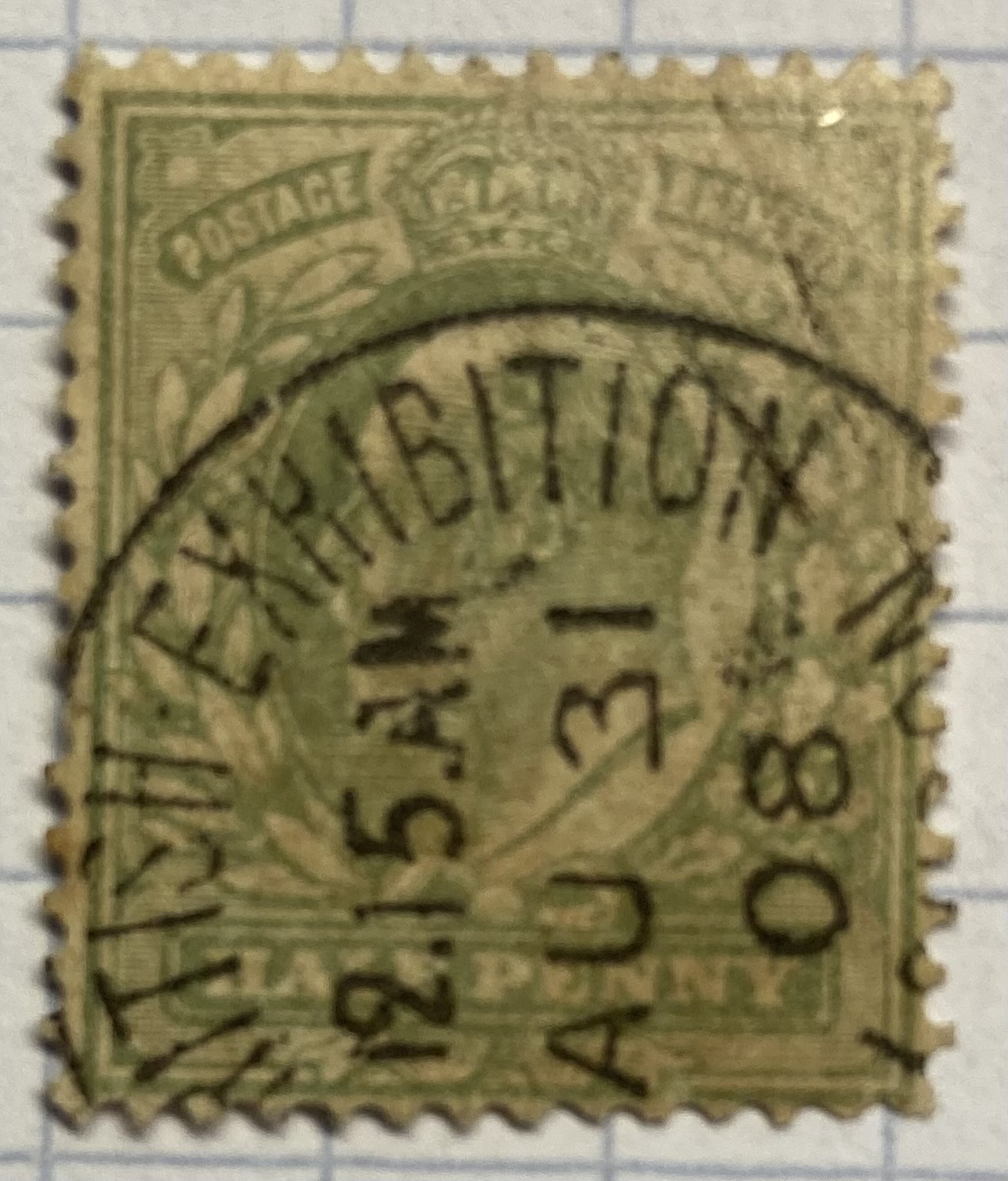
Consider the examples below. Someone was up late mailing letters, at 10:30pm in Edinburgh, Scotland on Jan 12, 1898, and just after midnight at the Franco-British Exhibition in London on Aug 31, 1908. A pyramid looms and the sphinx peers behind a stamp postmarked in Luxor at some point at the end of the 19th century (based on when that stamp was in circulation). While Queen Victoria has been blotted out and the sphinx is obscured, these marks turn the stamps into unique objects which situate them in history.
I add stamps like these to a special album I’ve created for postmarks. I’ll share samples from my collection here; they won’t be illustrative of all postmarks from around the world, but reflect whatever I happen to have. I’ll also link to pages that provide information about particular series that were widely published and popular for collecting. Check out this introduction on stamp collecting from the National Postal Museum at the Smithsonian if you’d like a primer. They are also an excellent reference for US stamps.

Time and Place in Cancellation Marks

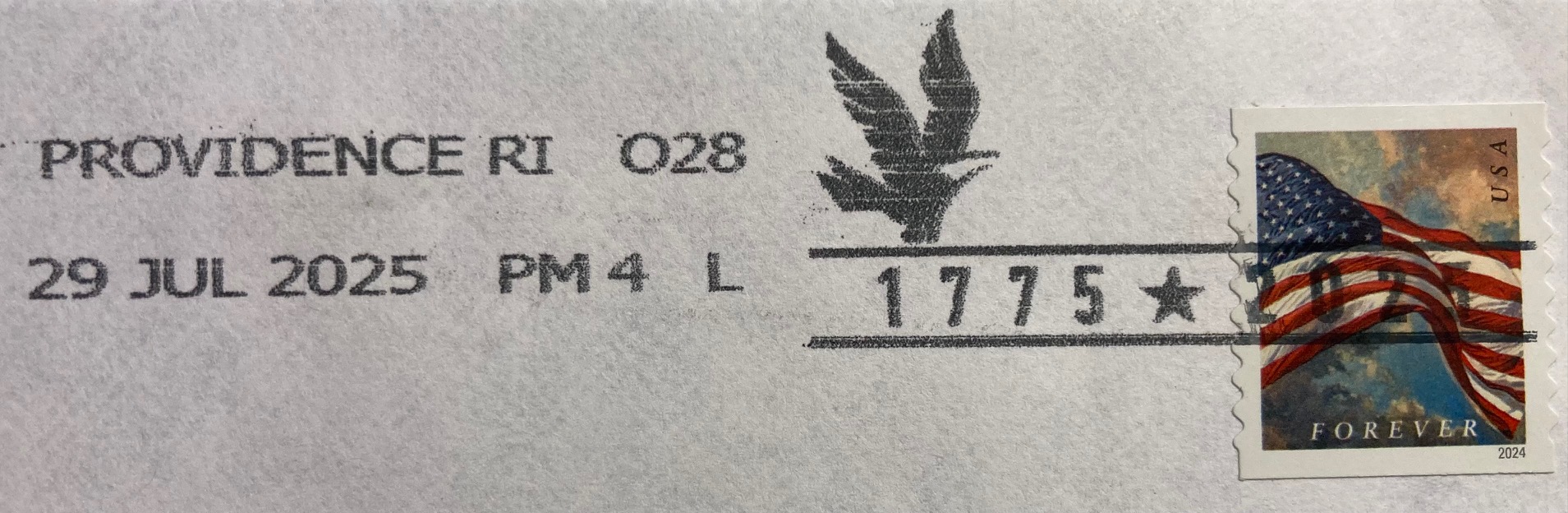
In the late 20th century, the time and place on standard North American postmarks appeared in a circular mark that contained the date and city where the letter was processed, followed by empty space and then wavy lines, bars, or a public service message that cancelled the stamp, as we can see in the early 1980s examples below (the “Please Mail Early for Christmas” cancellation appears atop a stamp from the popular US Transportation Coil series of the 1980s and 90s). This postmark convention continues today in the early 21st century, with time and place on the left and cancellation on the right; the mark in the last example celebrates the 250th anniversary of the beginning of the American Revolution.
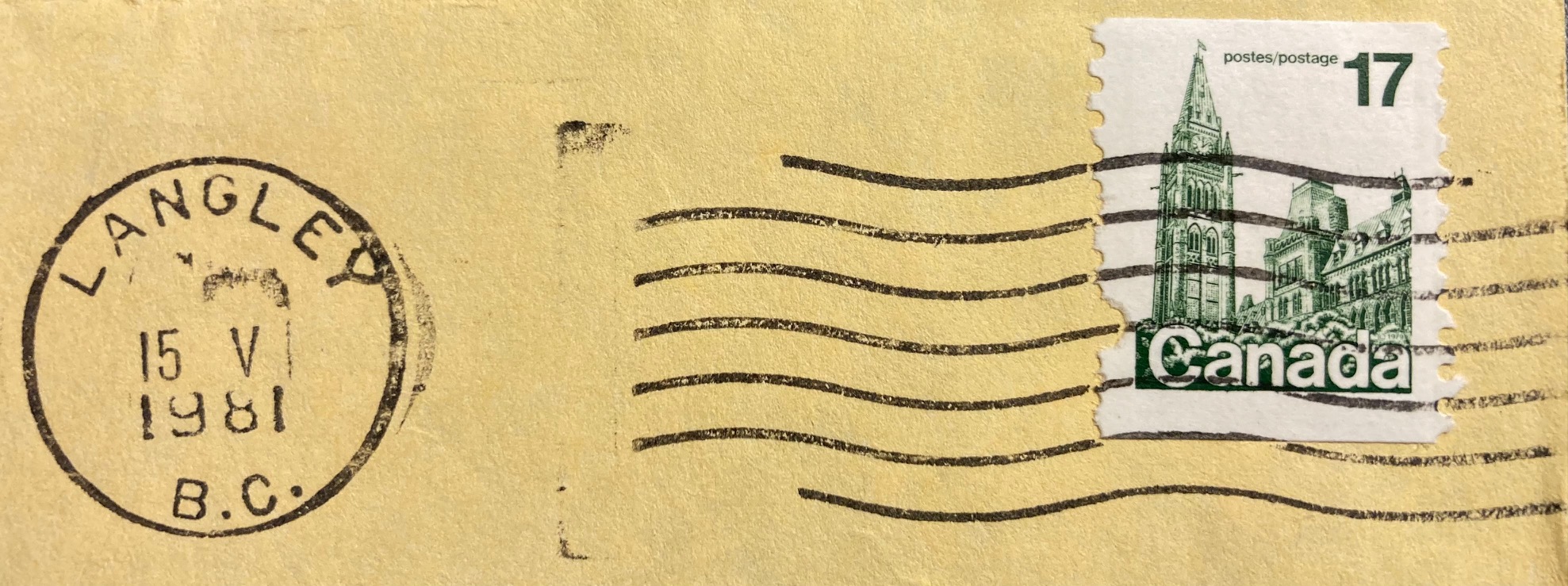
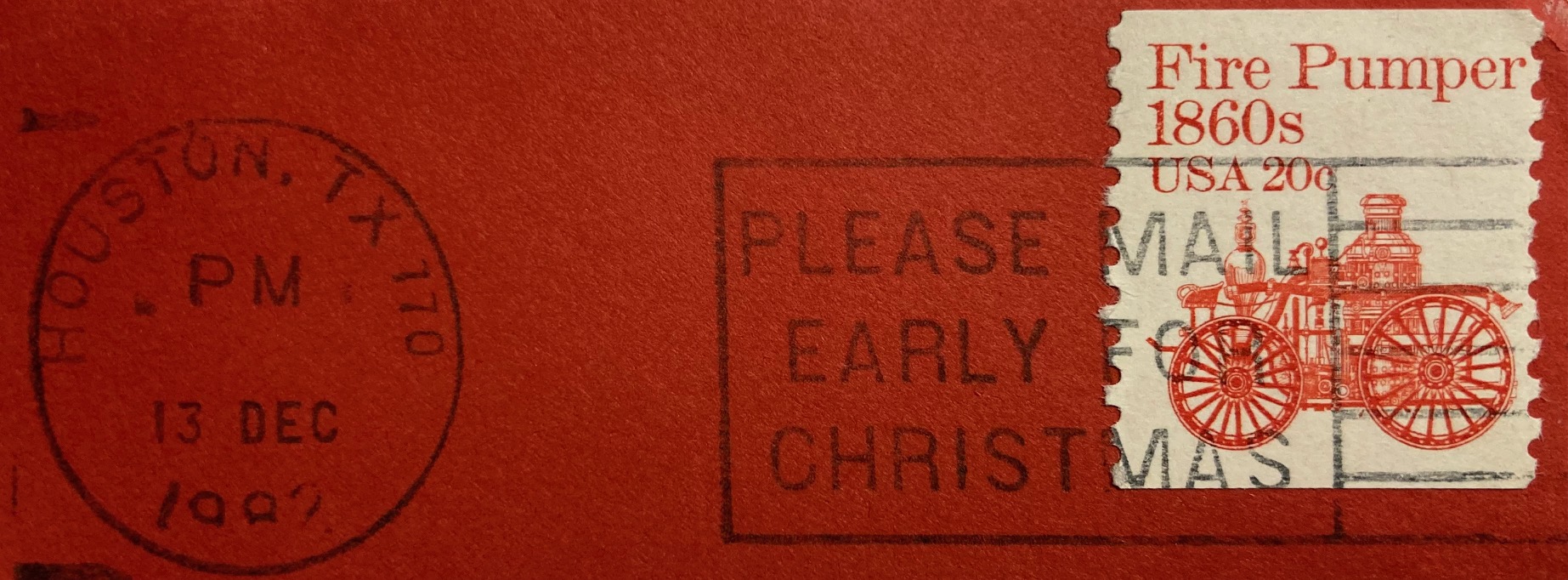
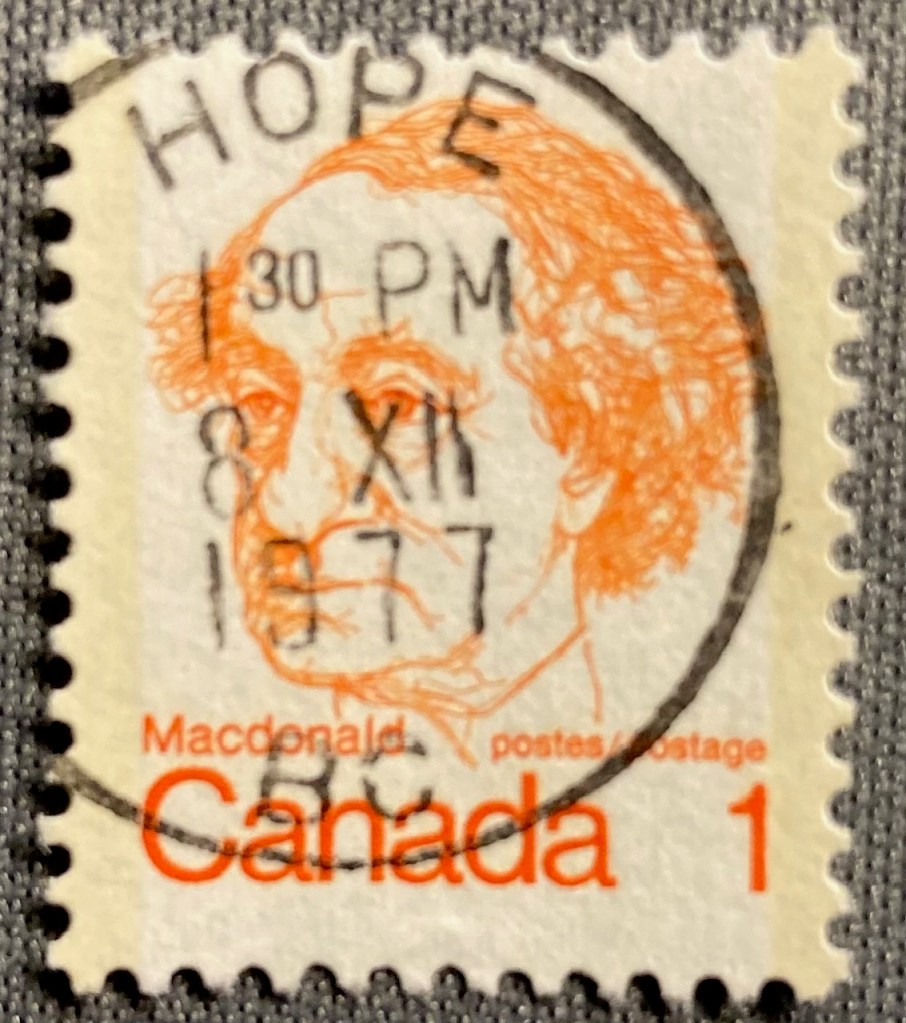
Given the placement of the marks, the date and place often don’t appear on these US and Canadian stamps; you would need a piece of the envelope to see the provenance. But sometimes you get lucky. This low denomination stamp was probably one of two or three stamps on its letter; given it’s position on the envelope the mark landed squarely on the prime minister. Hope is a virtue, and also a place in British Columbia where a letter was mailed on Dec 8, 1977 (December being the 12th month, XII in Roman numerals which Canada used on its postmarks)

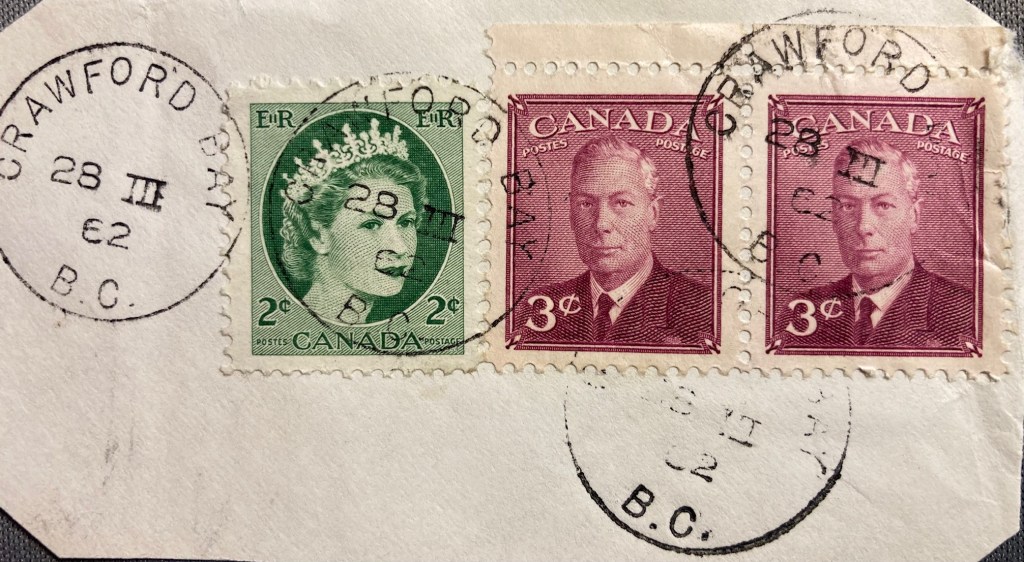
If we go further back in time to periods before mail was processed mechanically, or to places that didn’t have this equipment, we begin to see more stamps that were cancelled by hand, and we’re more likely to see the origin and date marked on the stamp. Queen Elizabeth II appears with her father King George VI on a letter from Crawford Bay, BC on March 28, 1962. QE II is probably the most widely depicted person on postage stamps; this series is known as Canada’s Wildings, their main definitive stamp from the 1950s to early 60s. The photo was taken by Dorothy Wilding, whose photos were also used for the UK’s 1950s definitive stamps of the queen (which are known by collectors as The Wildings). I should add, “definitives” are the small, basic, and most widely printed stamps that countries issue. Think of stamps of the flag in the US, or the queen (or now, the king) in the UK and Canada (Canadians also employ their flag and the maple leaf quite a bit).
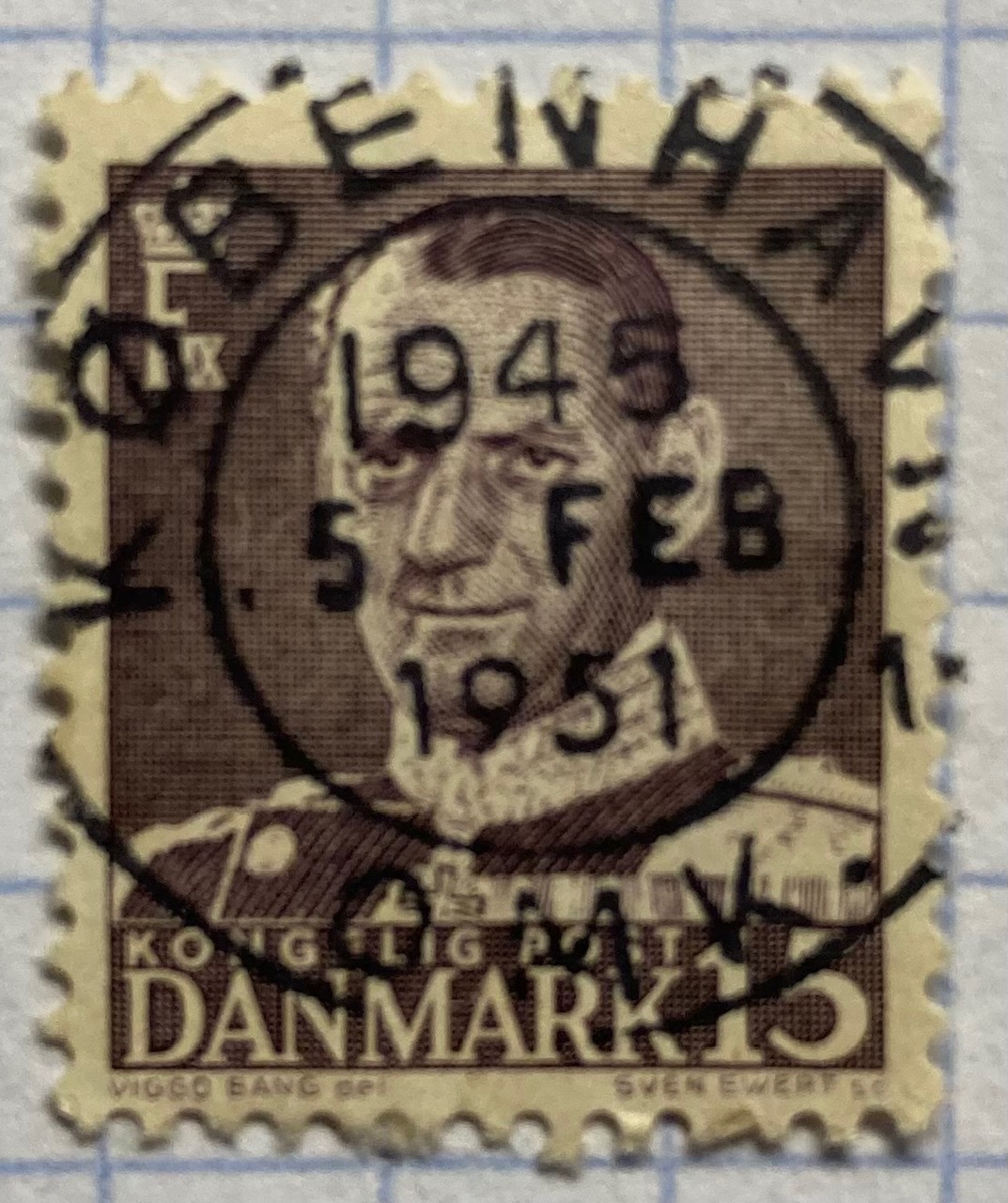
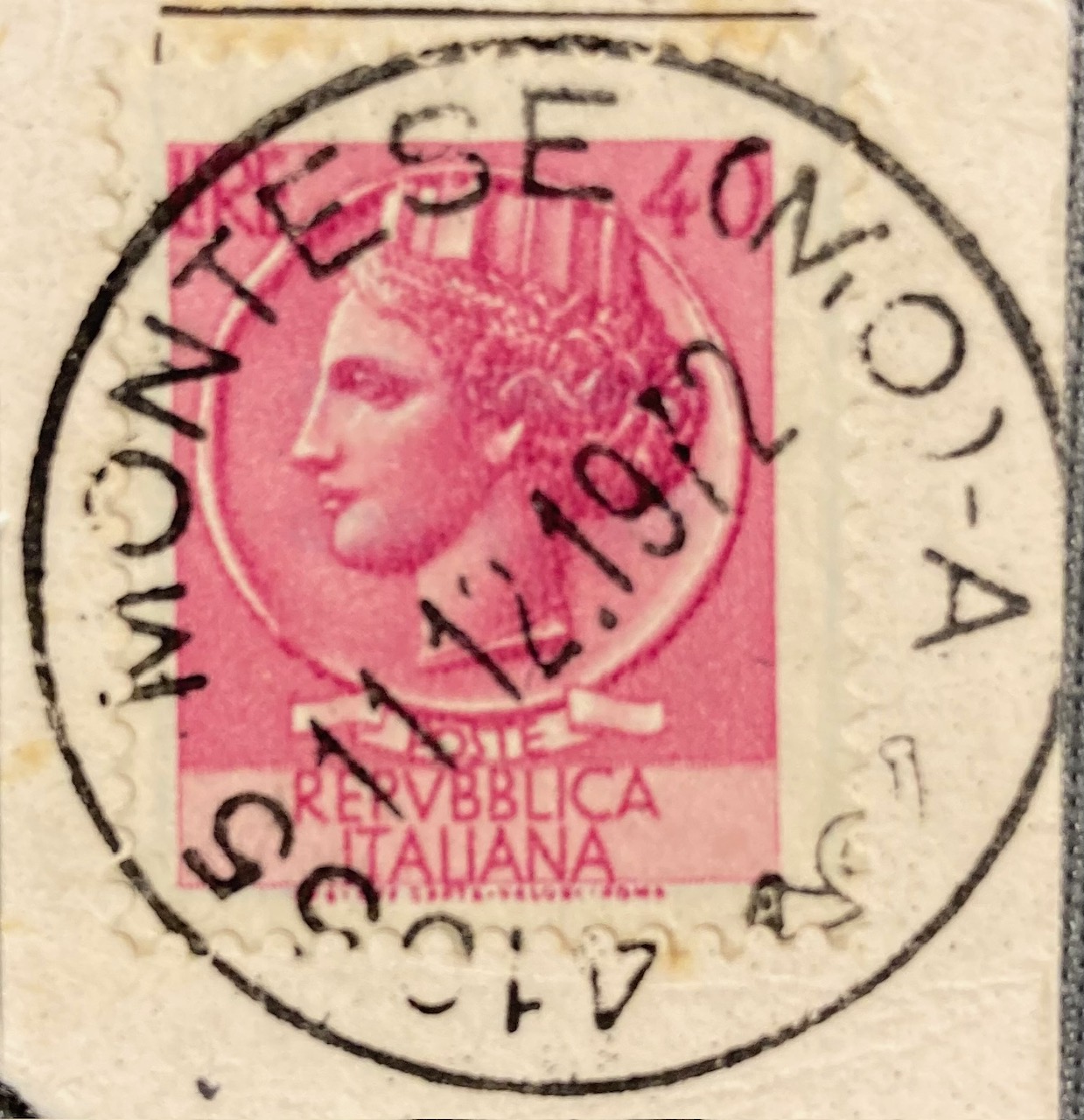
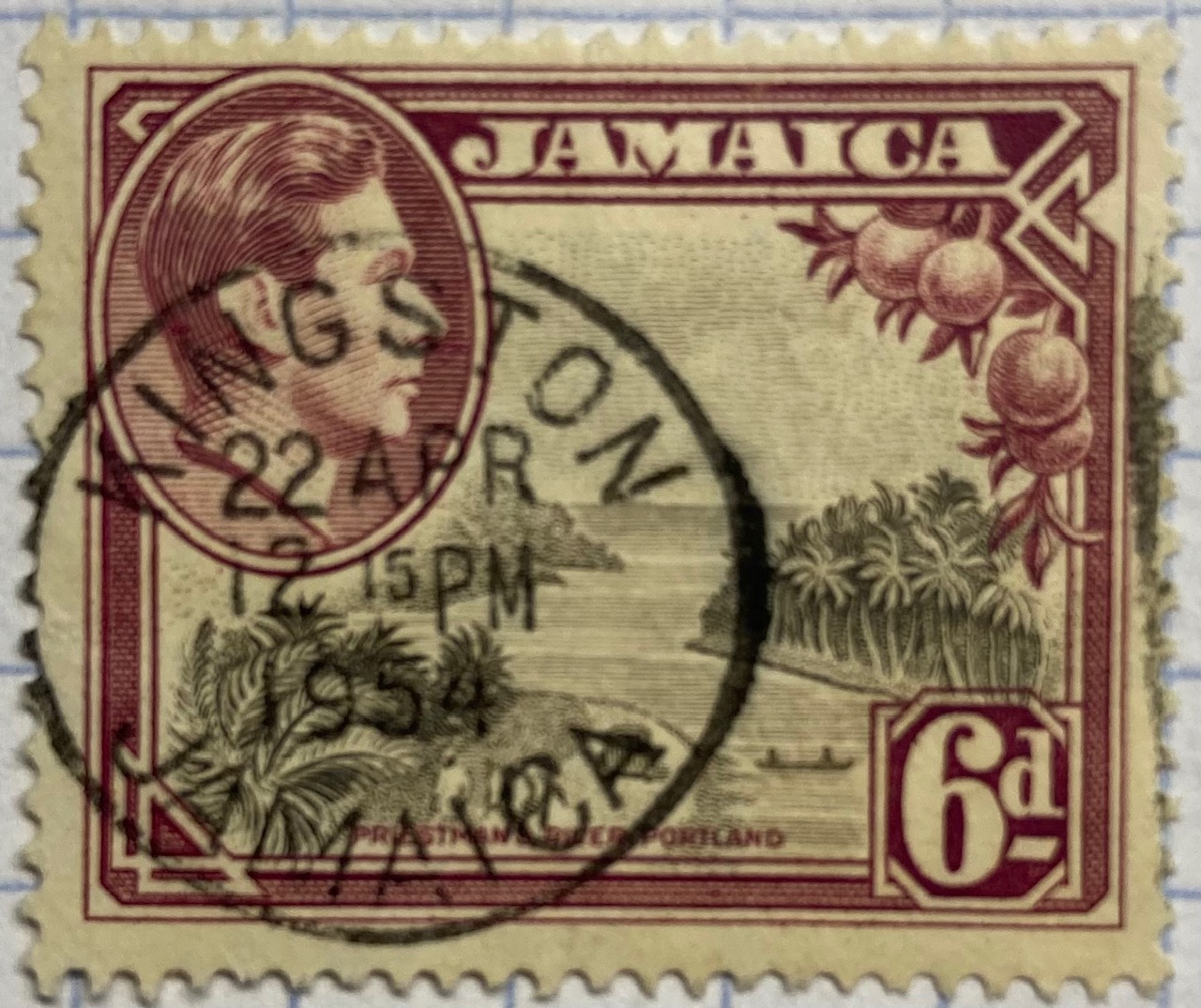
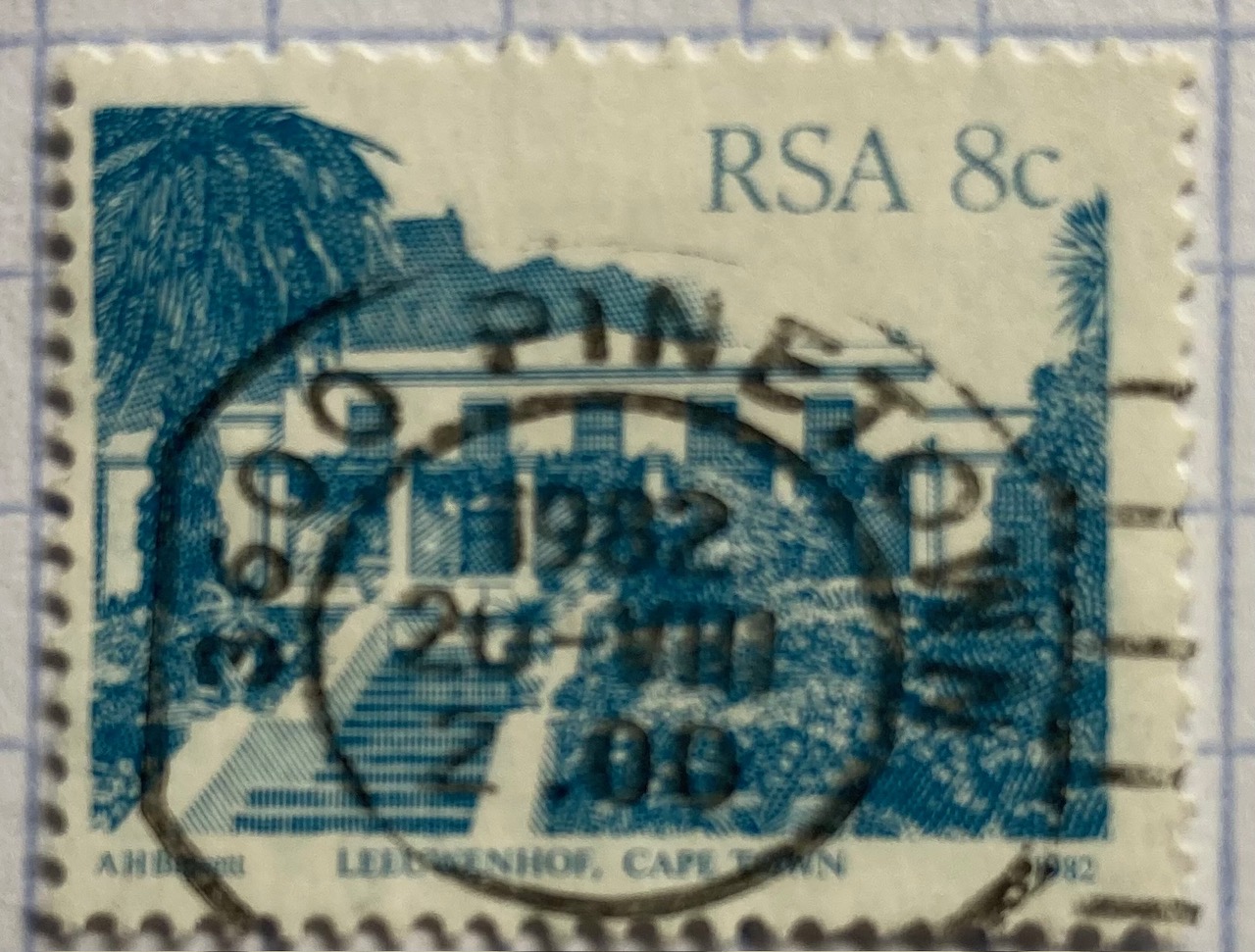
Postmarks vary over time and place with many countries having distinct cancellation styles, and where the markings may appear on the stamp itself. The examples below depict marks that “hit the spot”, on afternoons in 1954 in Kingston, Jamaica and 1982 in Pinetown, South Africa (ten miles from Durban). The marks on the Danish and Italian stamps are a bit larger than the stamps themselves, but we can still make out Kobenhavn (Copenhagen) in Denmark. The year is 1951; the 1945 at top is actually 19:45 hours as they use the 24-hour clock (7:45pm). Since the Coin of Syracuse (the definitive Italian stamp from the 1950s through the 70s – this one cancelled in 1972) is still on the envelope, we can see it originated in Montese, a town in the Emilia-Romagna region of northern Italy.
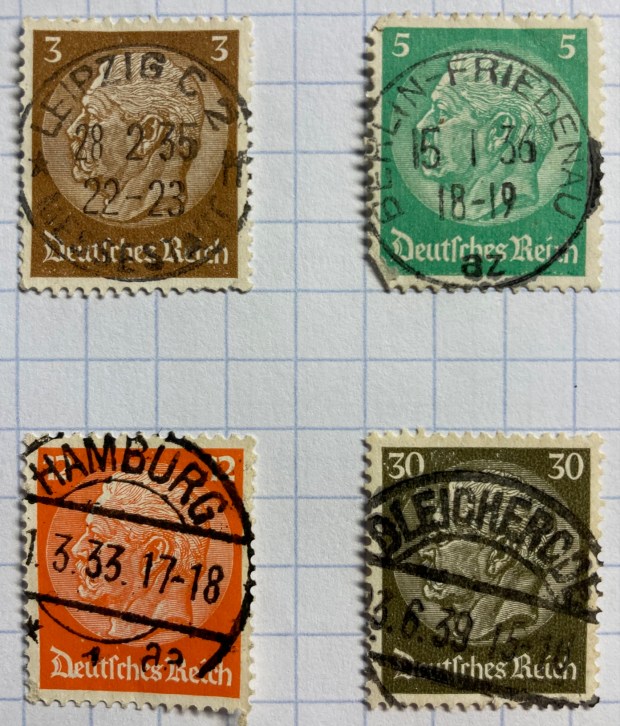
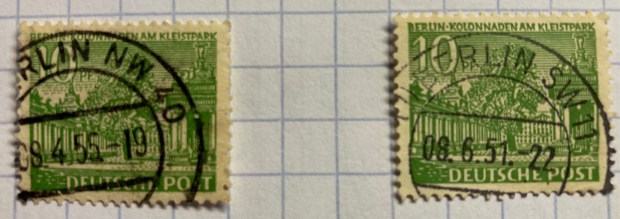
German stamps had a couple of distinctive marks in the mid 20th century, which often landed directly on the stamp. If you acquire enough of these you can assemble a collection that represents cities across the country. The 1930s examples below depict Paul Von Hindenburg, a WWI general and later president of the Weimar Republic. After WWII, Germany and the city of Berlin were divided into occupation zones; we can see examples from the Northwest and Southwest Berlin zones canceled in the 1950s.
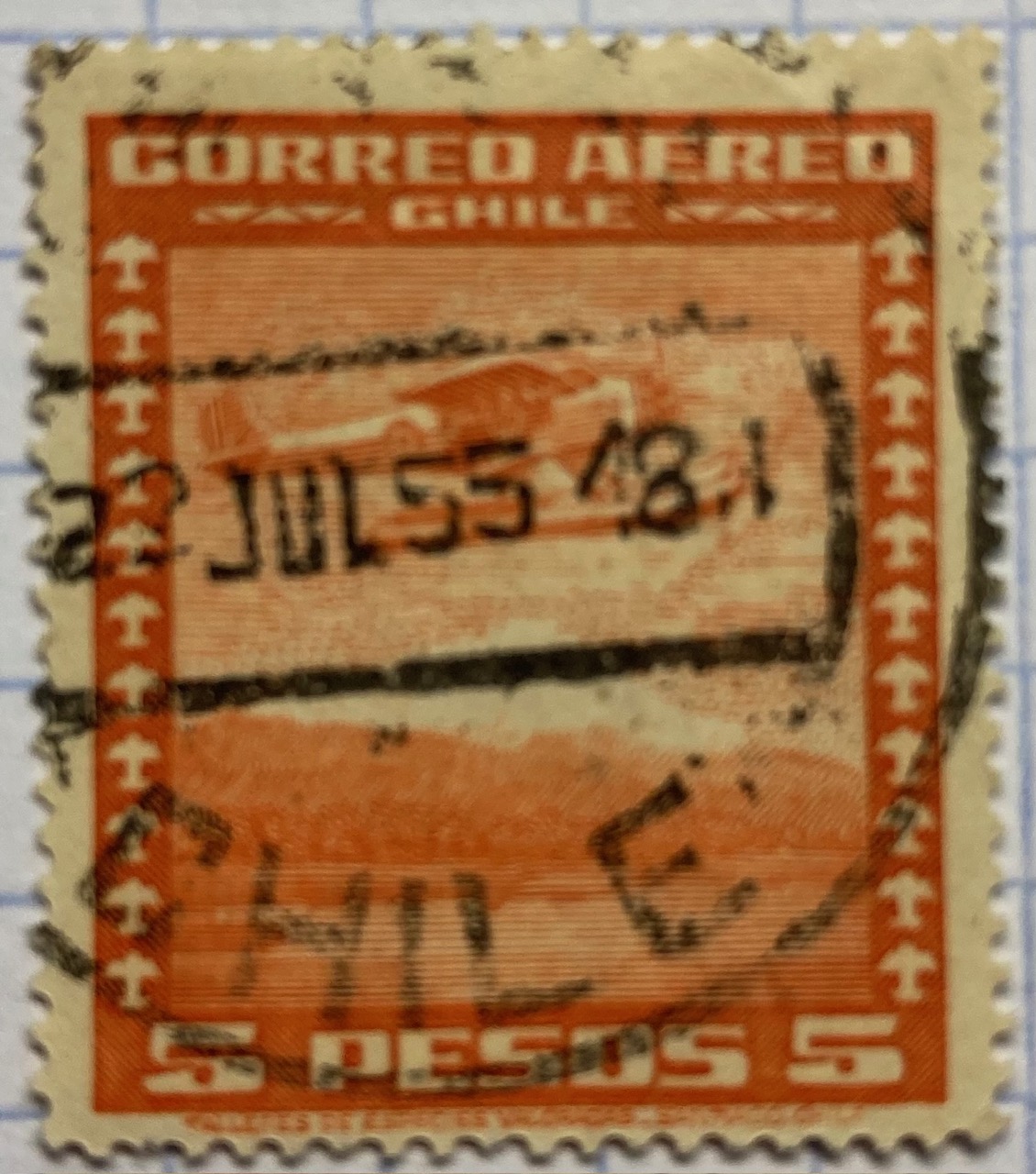
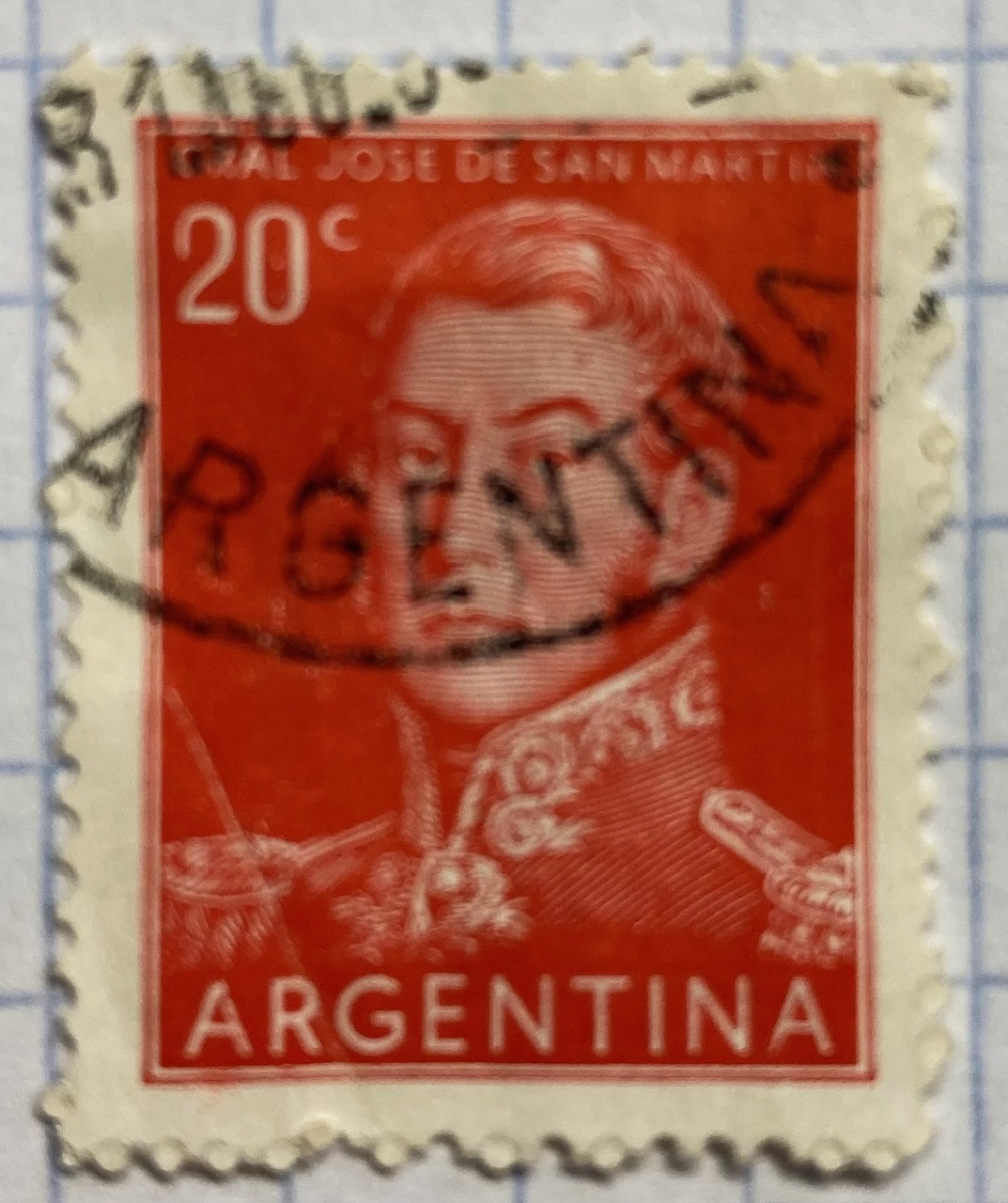
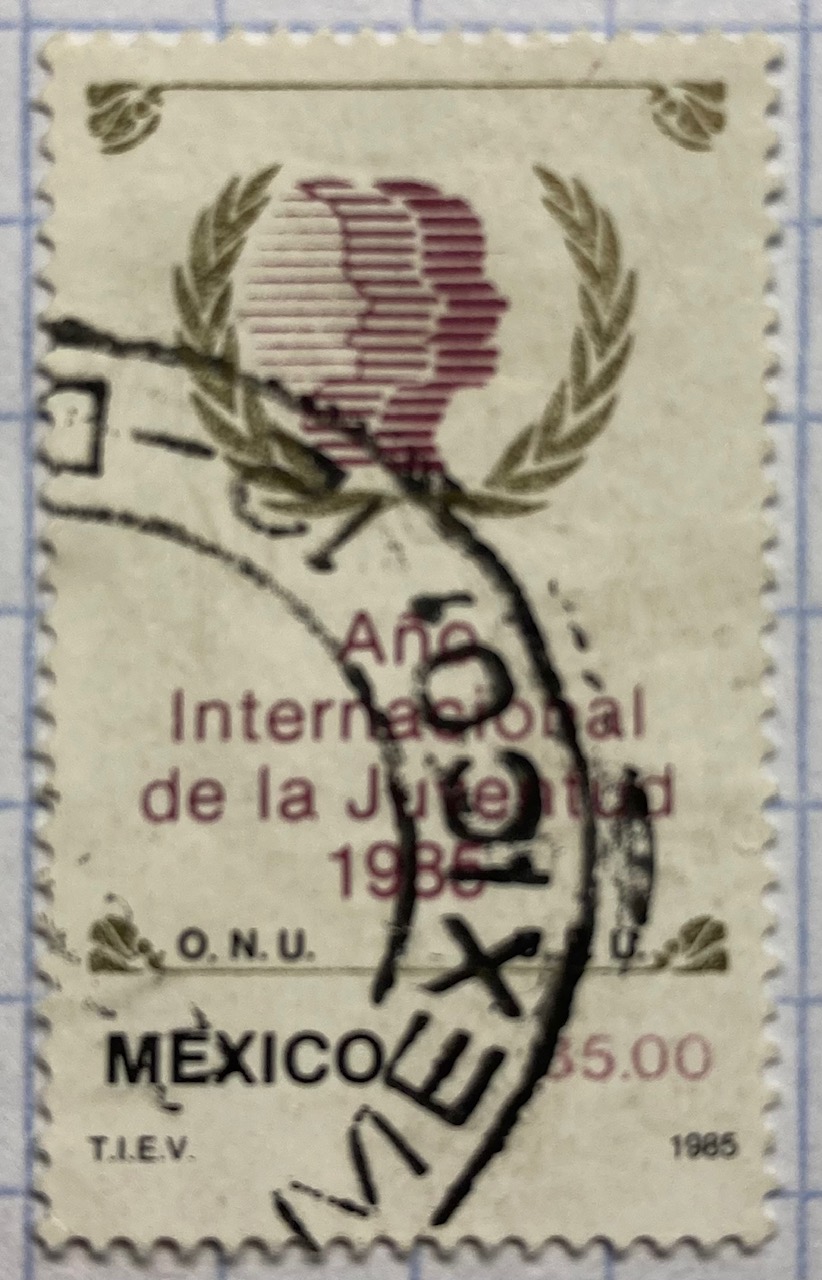
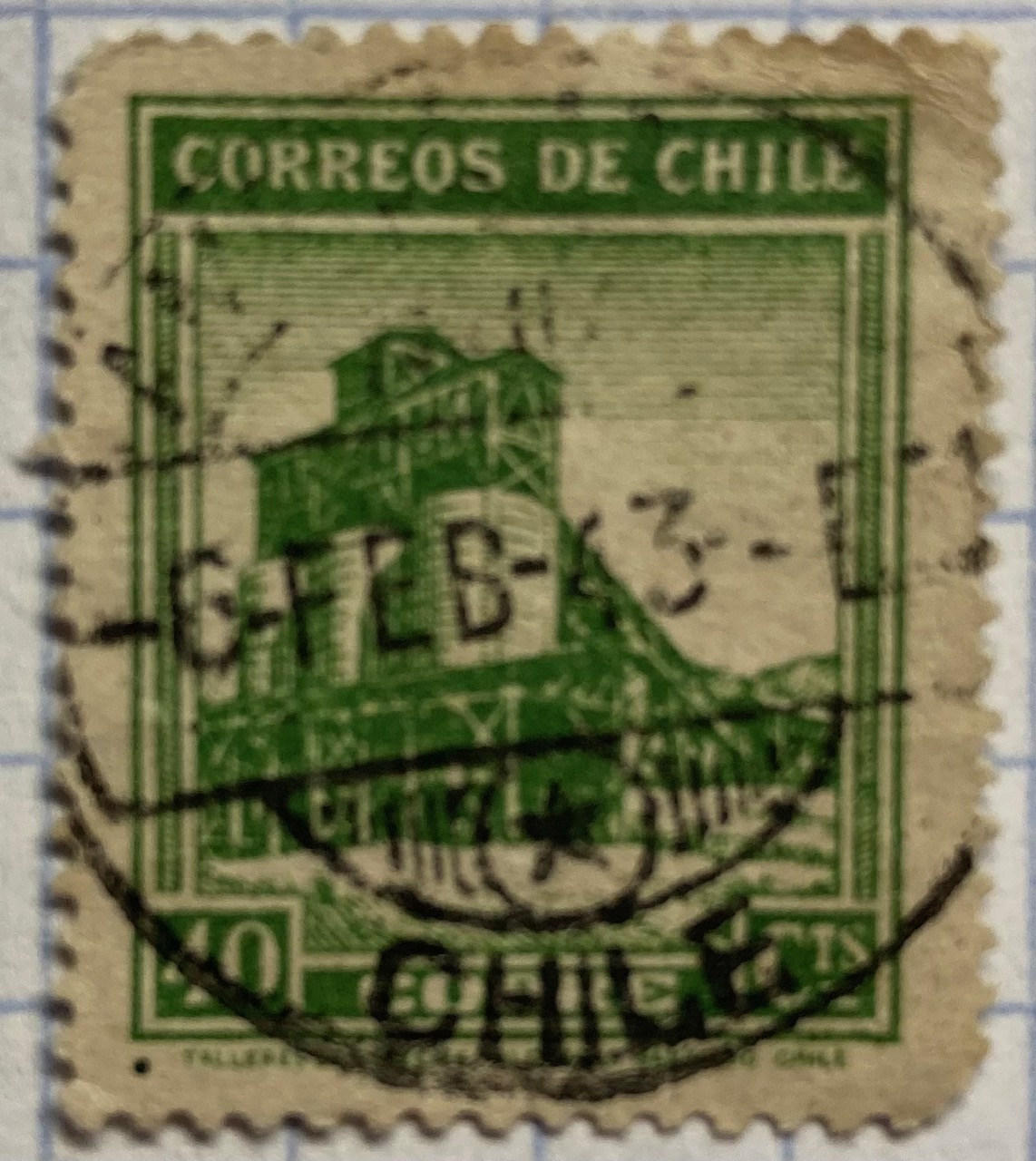
The postmarks in these Latin American stamps incorporate their country of origin.
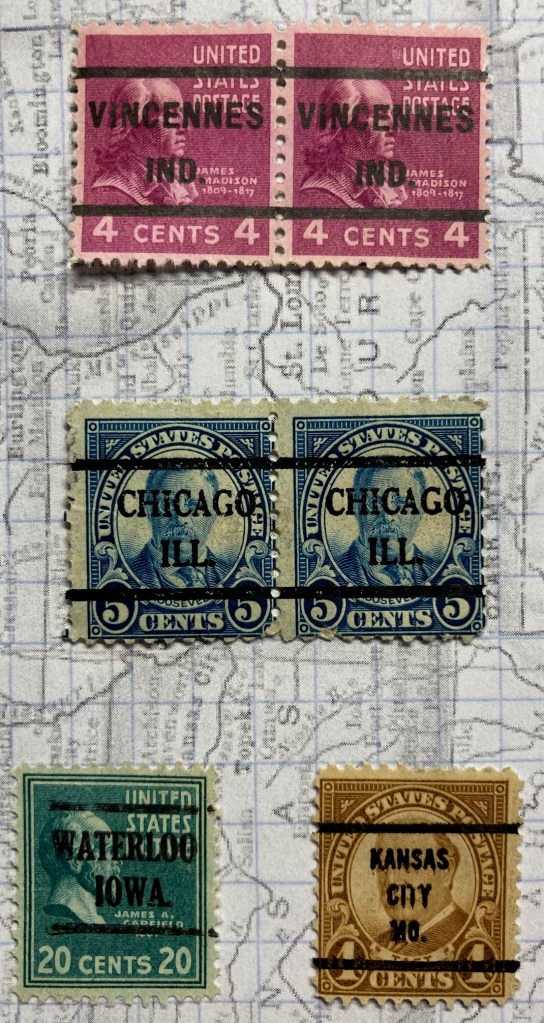
Back in North America, in the first half of the 20th century post offices issued pre-cancelled stamps that bore the mark of the city where they were distributed. Pre-cancelling was an early solution for saving time and money in processing large volumes of mail. In the US, you’ll see these on definitive stamps from the 1920s to the 1970s, particularly on the 4th Bureau Issues (1922-1930) (example of 4c Taft and 5c Teddy Roosevelt on the left), and the Presidential Series of 1938, known as the ‘Prexies”. This series was proposed by Franklin Roosevelt, who was an avid stamp collector, and it depicted every president from Washington to Coolidge. Given the wide range of stamps and denominations, they remained in circulation into the 1950s.
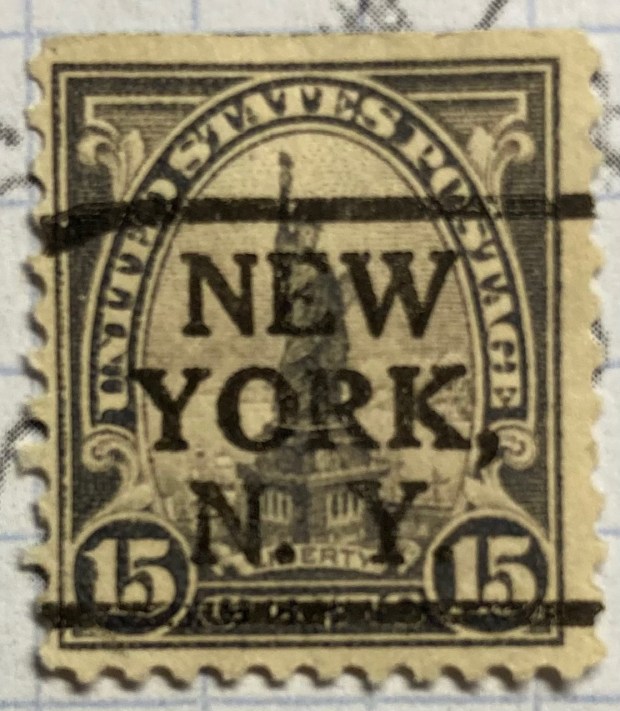
If you’re lucky, you can discover some interesting connections between the postmark and the subject depicted on the stamp, like this 4th Bureau, 1920s stamp of the Statue of Liberty, prominently pre-cancelled in New York.

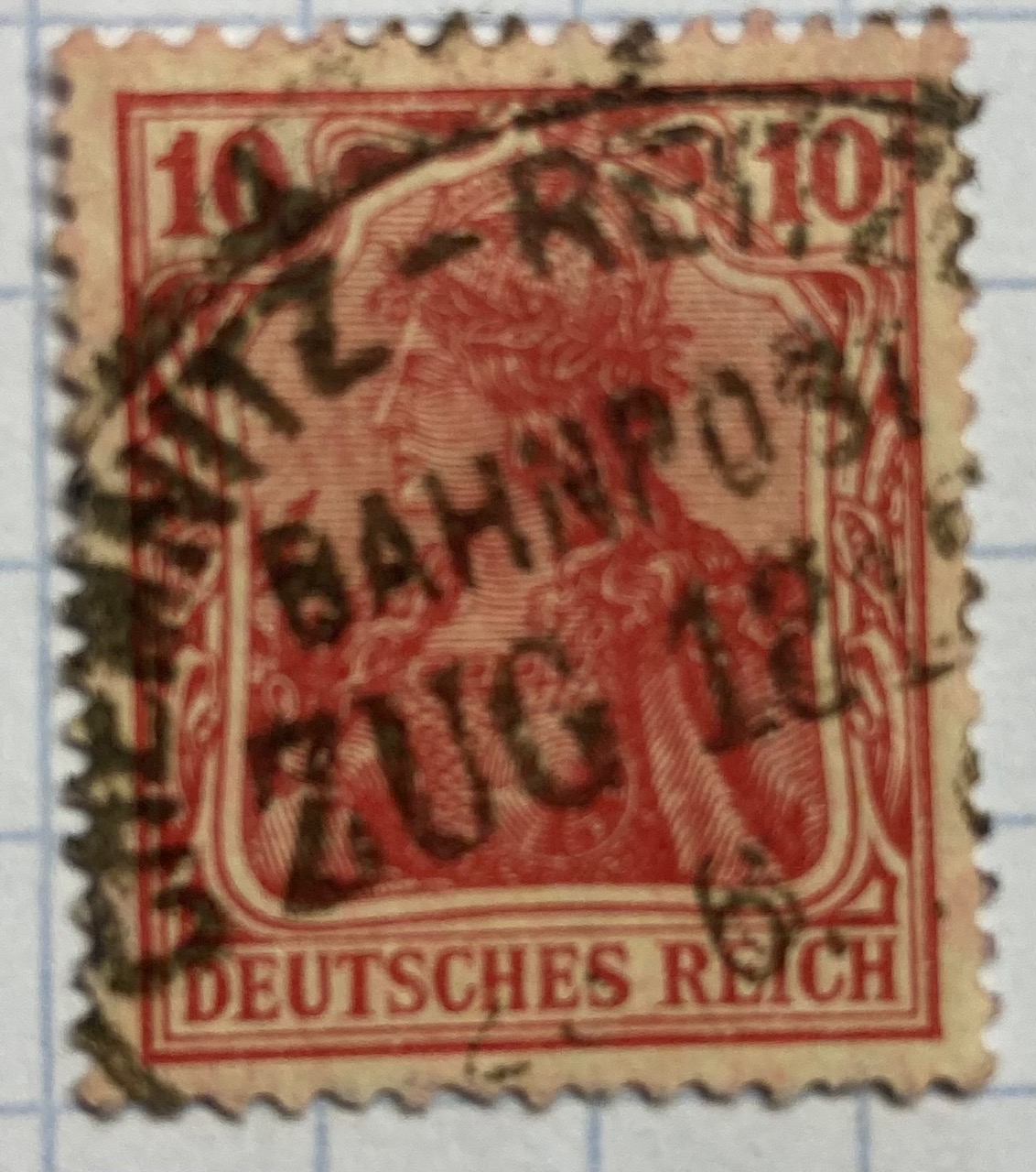
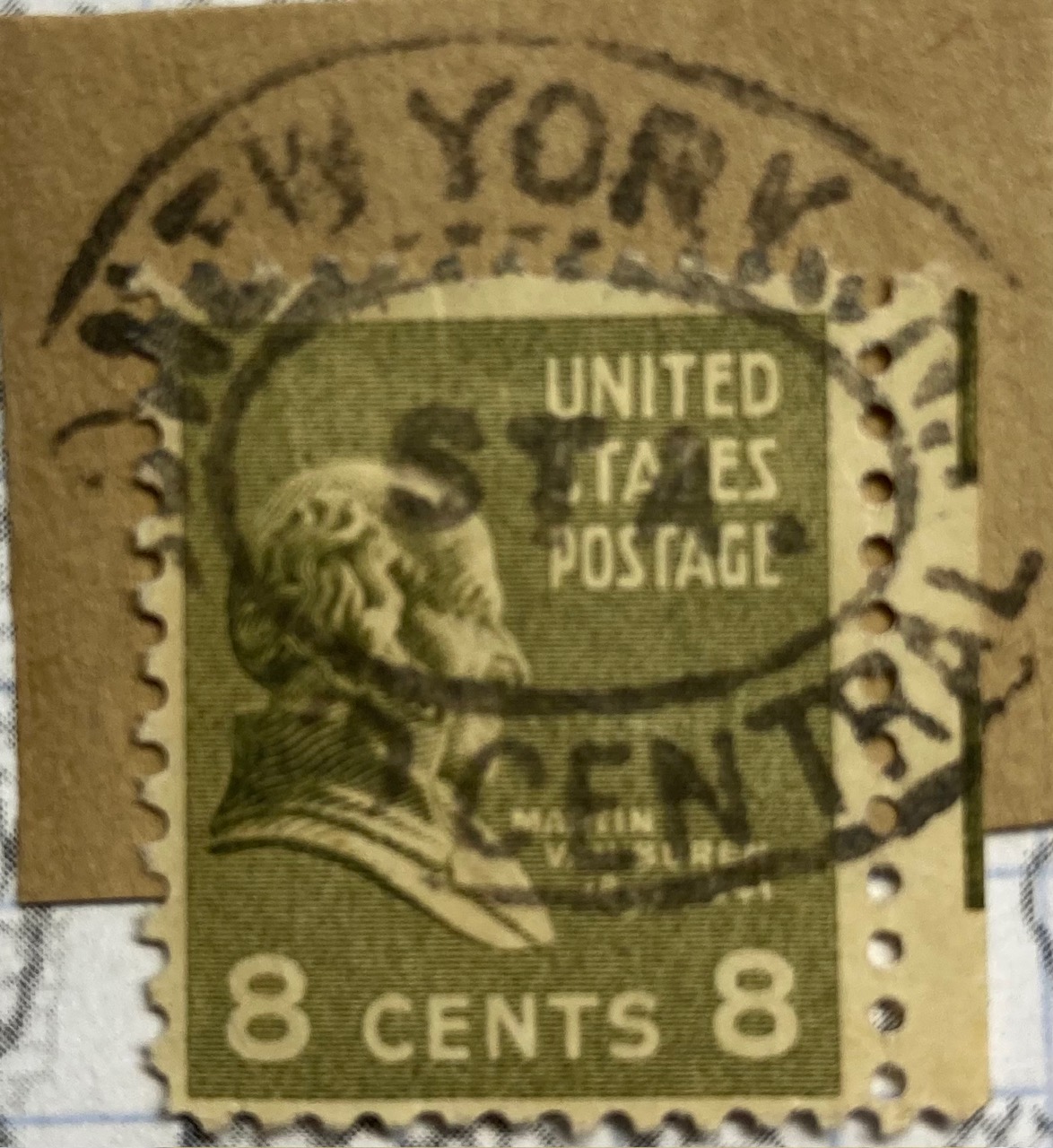
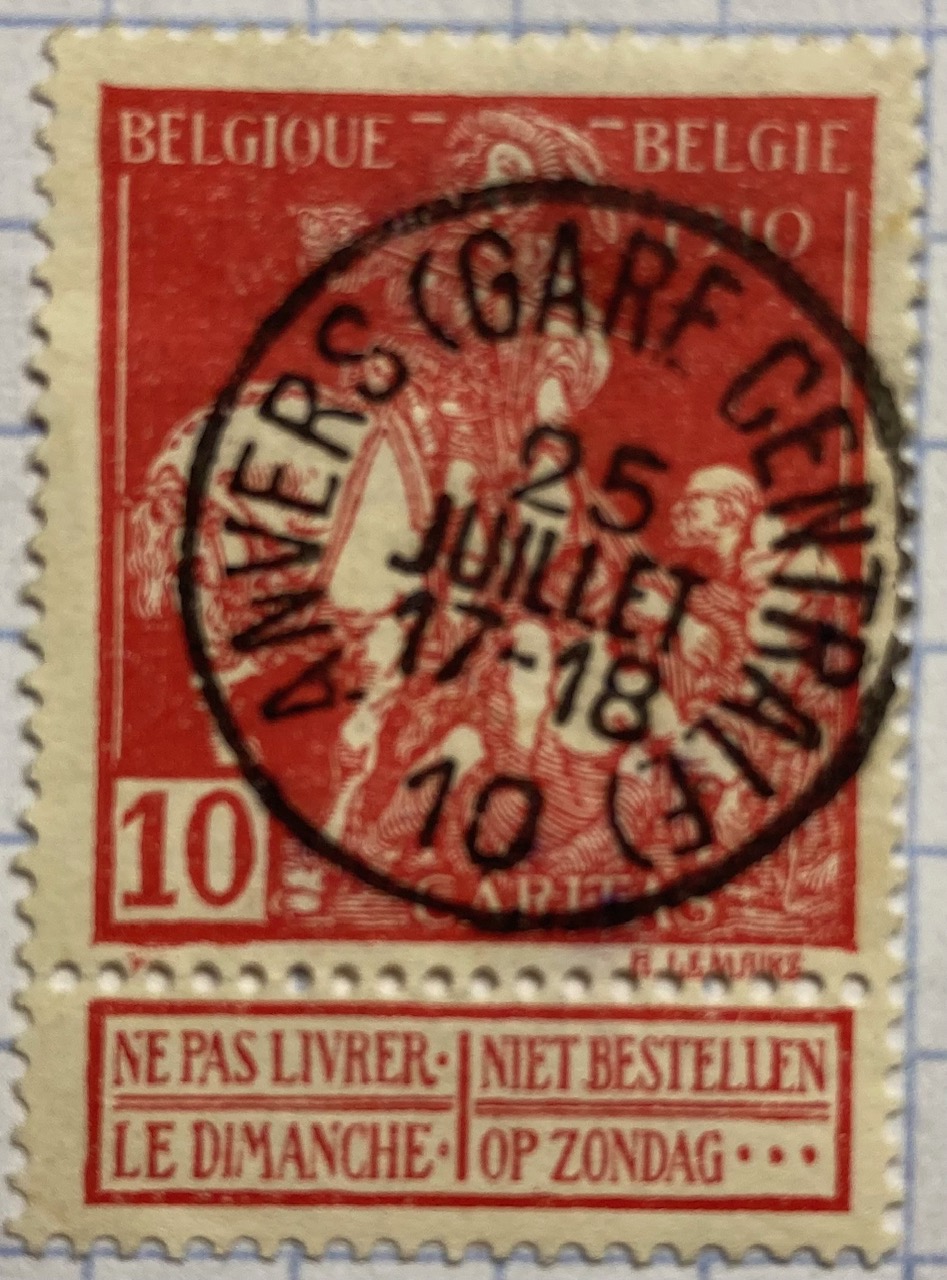
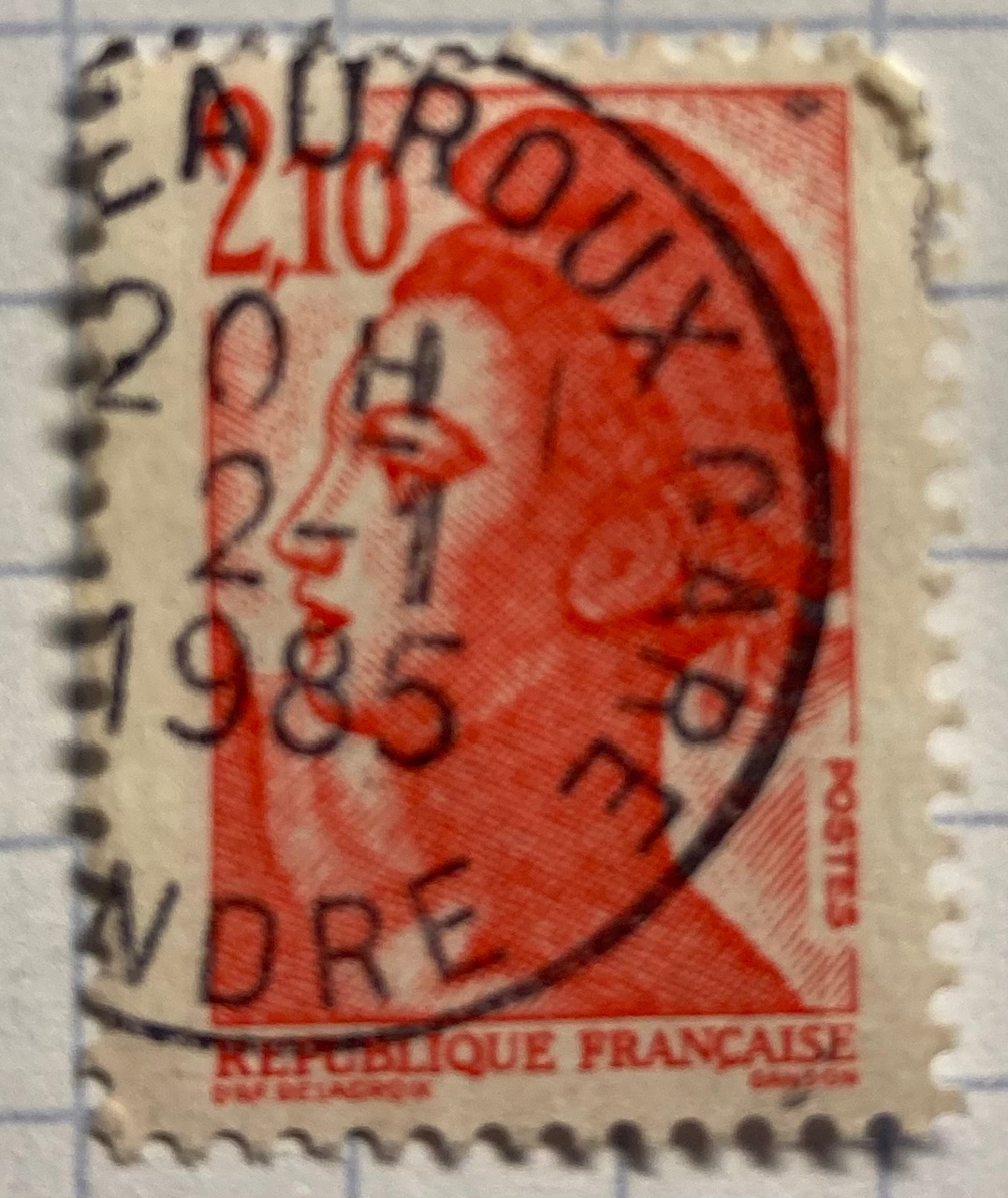
Mail was often transported by train, and train stations were key points where passengers would mail letters before and after traveling, and in some cases even on the train if there was a postal car. “Gare” is the French term for “station”, and we see examples from 1910 Belgium and 1985 France below. An example from Germany is marked Bahnpost (“station” or “train” mail) on board a Zug (“train”) that left Chemnitz early in the 20th century. Since I still had a portion of the envelope, we know the Prexie stamp of Martin Van Buren traveled through Grand Central Station in NYC, at some point in the mid 20th century.
Parts of the Address

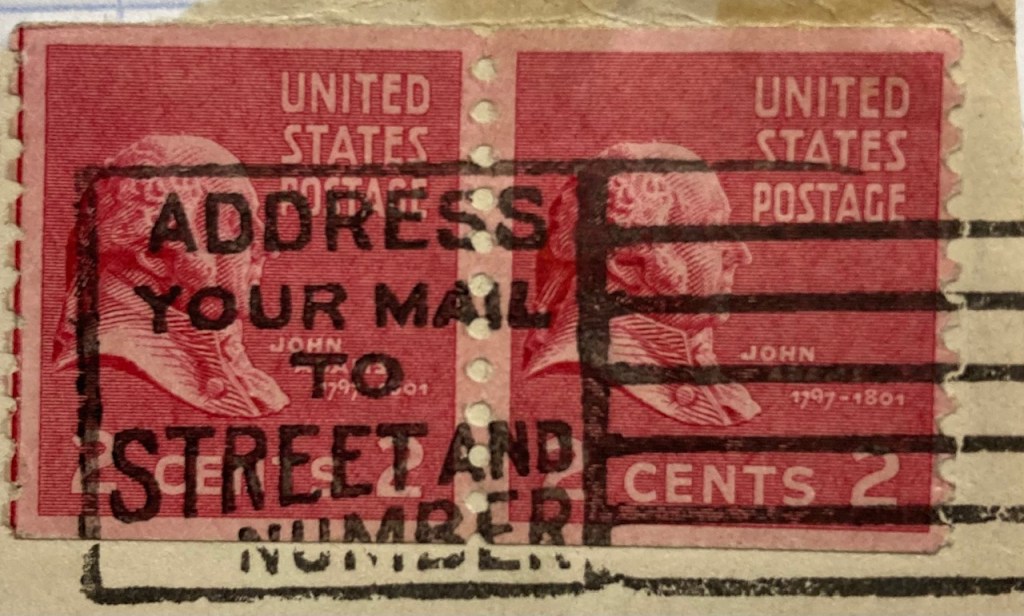
Beyond the cancellation mark that provides time and origin of place, geography also appears in postmarks as exhortations from post offices to encourage letter writers to address mail correctly, so that it ends up at the right destination. The development of addressing systems was, in part, prompted by the need to get mail to locations quickly and accurately. This mid-20th century mark on a pair of John Adams Prexies reminds folks to include both the street and house number in the address.
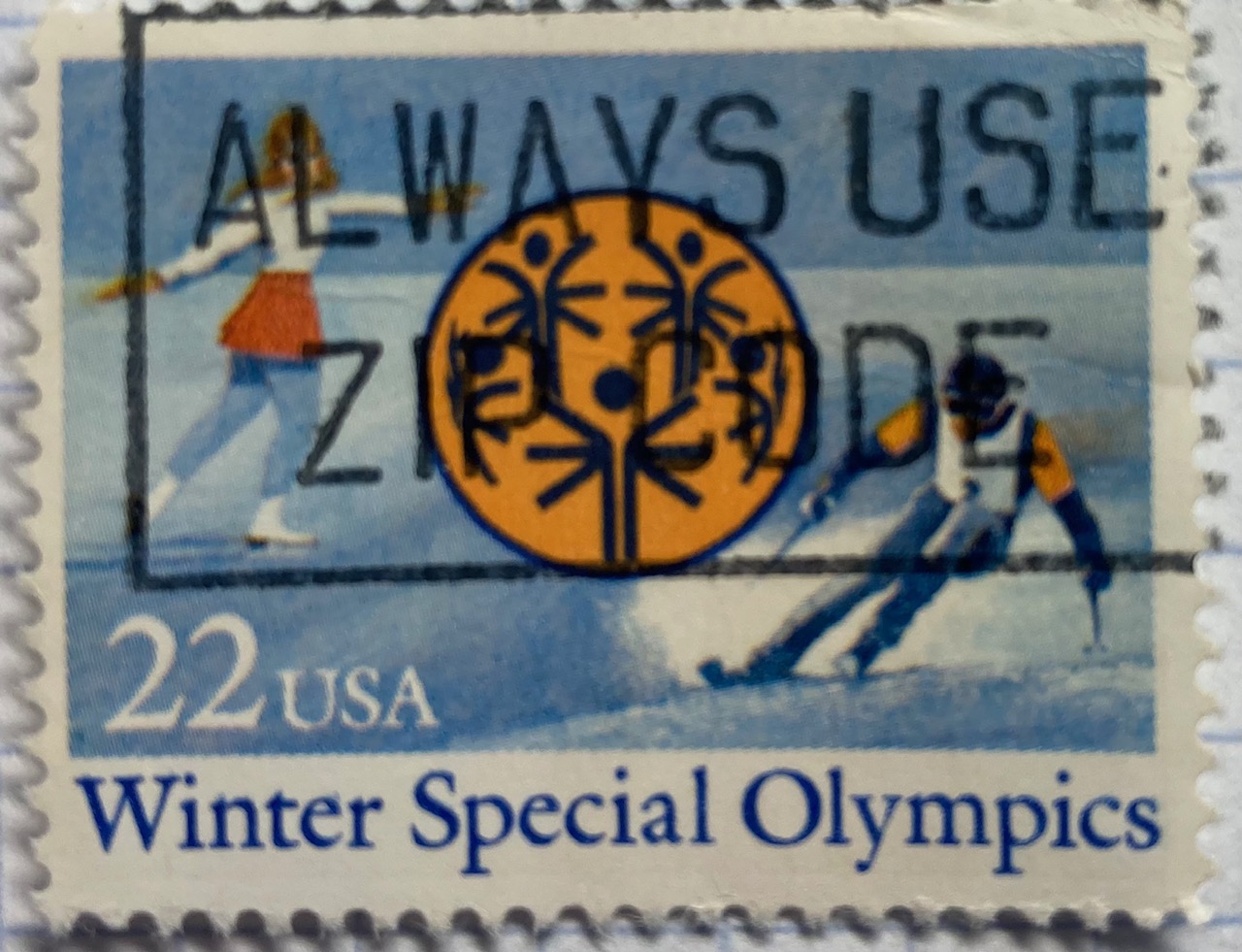
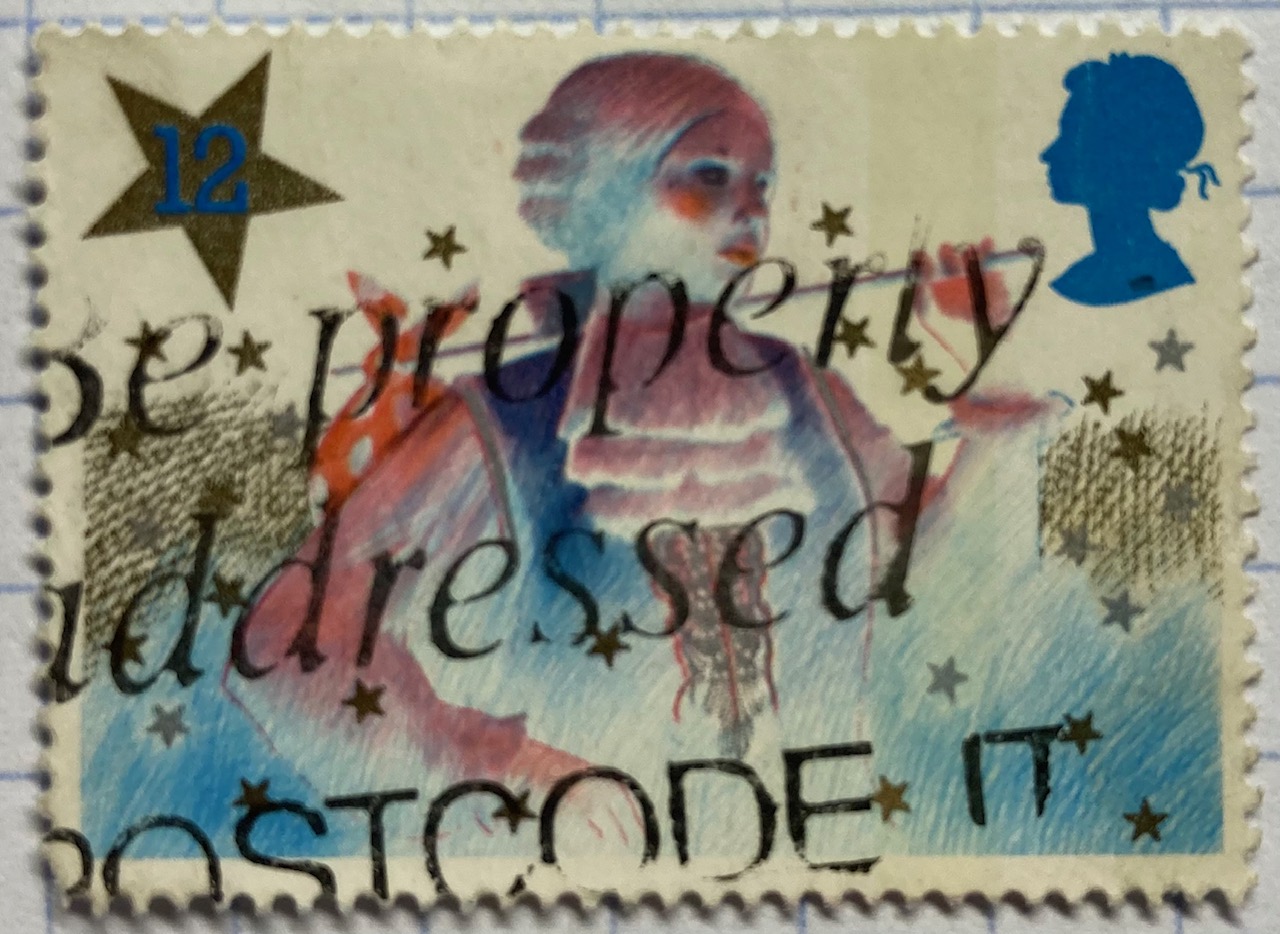
Postal codes were developed in the mid 20th century as unique identifiers to improve sorting and delivery, as the volume of mail kept increasing. The 1980s stamps below include an example from the US, where the ZIP Code or “Zone Improvement Plan” is the name of US postal code system (introduced in 1963). The USPS always wants you to use it. The other stamp comes from the UK, where the Royal Mail encourages you to “Be Properly Addressed” by adding your post code.
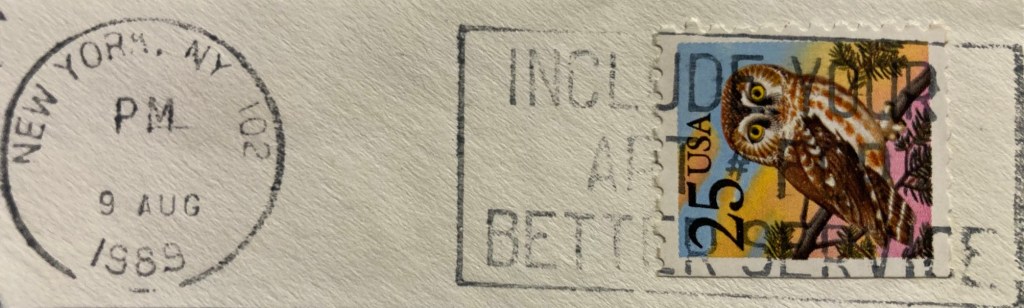
If you’ve ever lived in an apartment building, you’ve probably experienced the annoyance of not receiving letters and packages because the sender (or some computer system) failed to include the apartment number. This is particularly problematic in big cities like New York, so the post office regularly reminded folks with this special mark.
Celebrating Places in Postmarks

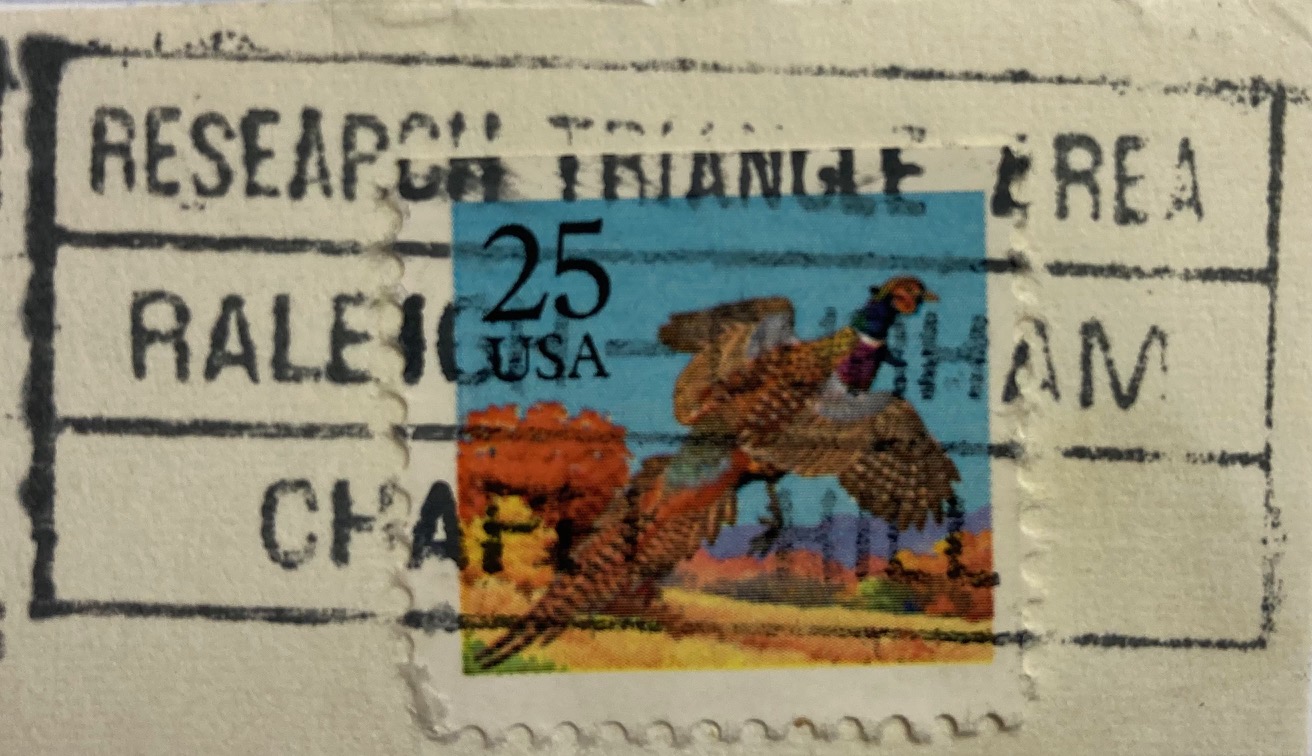
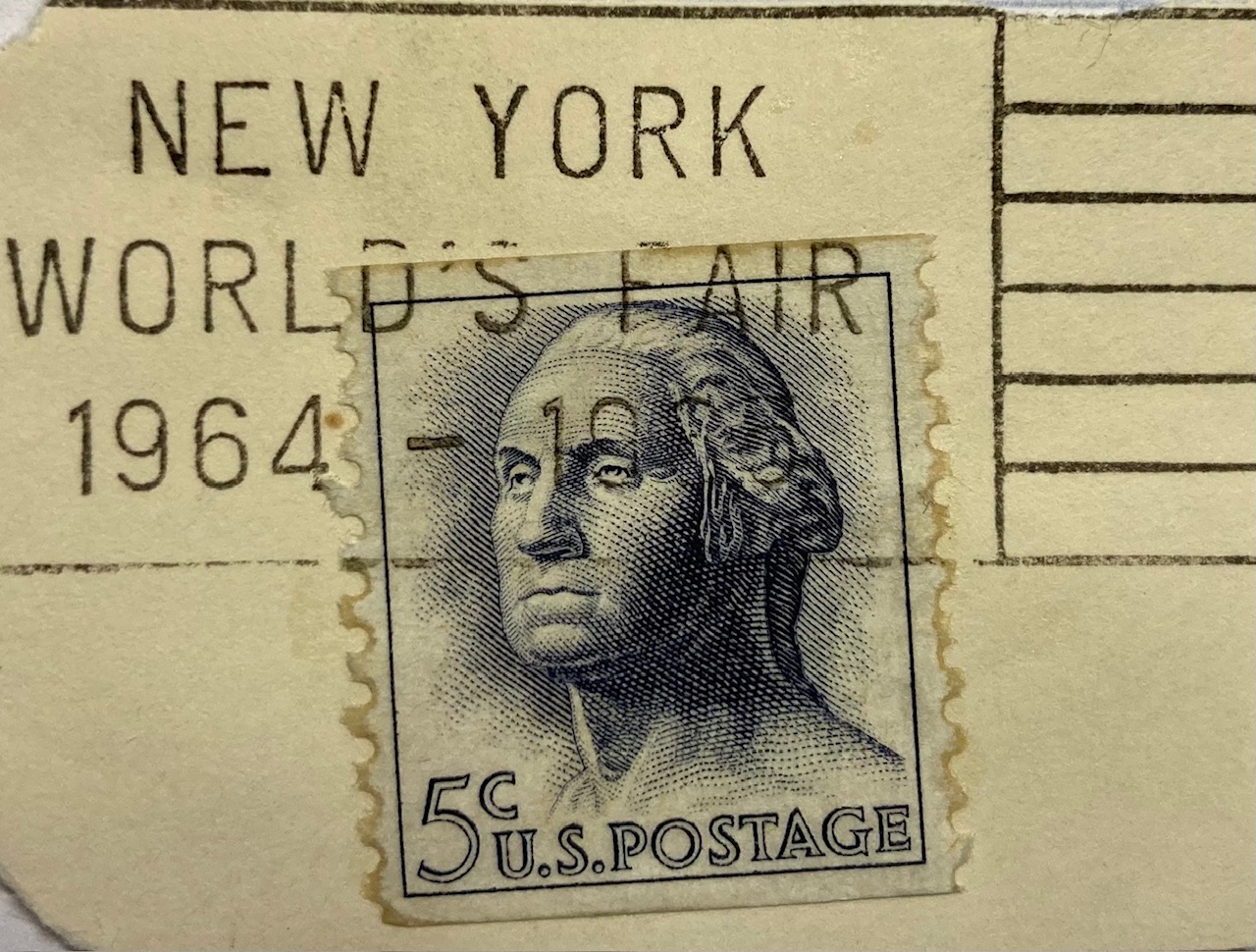
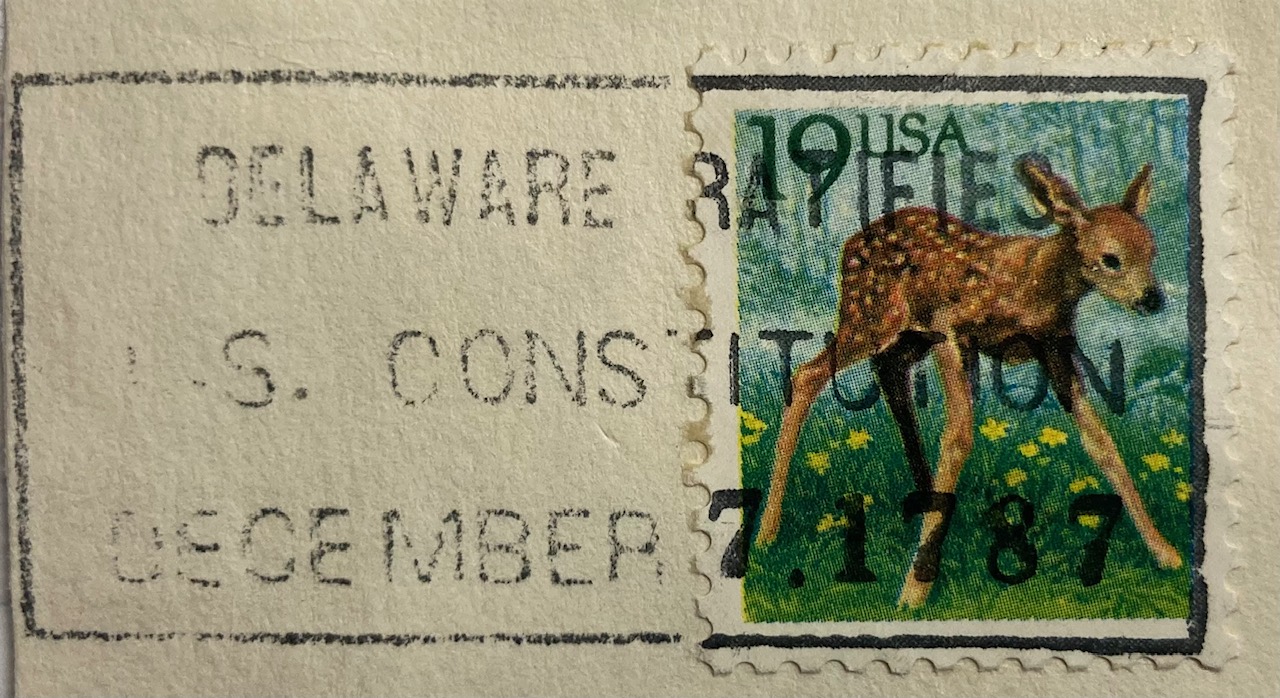
The most interesting examples of geography in postmarks are special, commemorative markings celebrating specific places and events tied to particular locales. Some of the marks have utilitarian designs like the ones below, commemorating the World’s Fair in New York in 1964 – 65, celebrating Delaware’s 200th anniversary of being the first state to ratify the Constitution, and promoting the burgeoning Research Triangle in North Carolina in the 1980s.
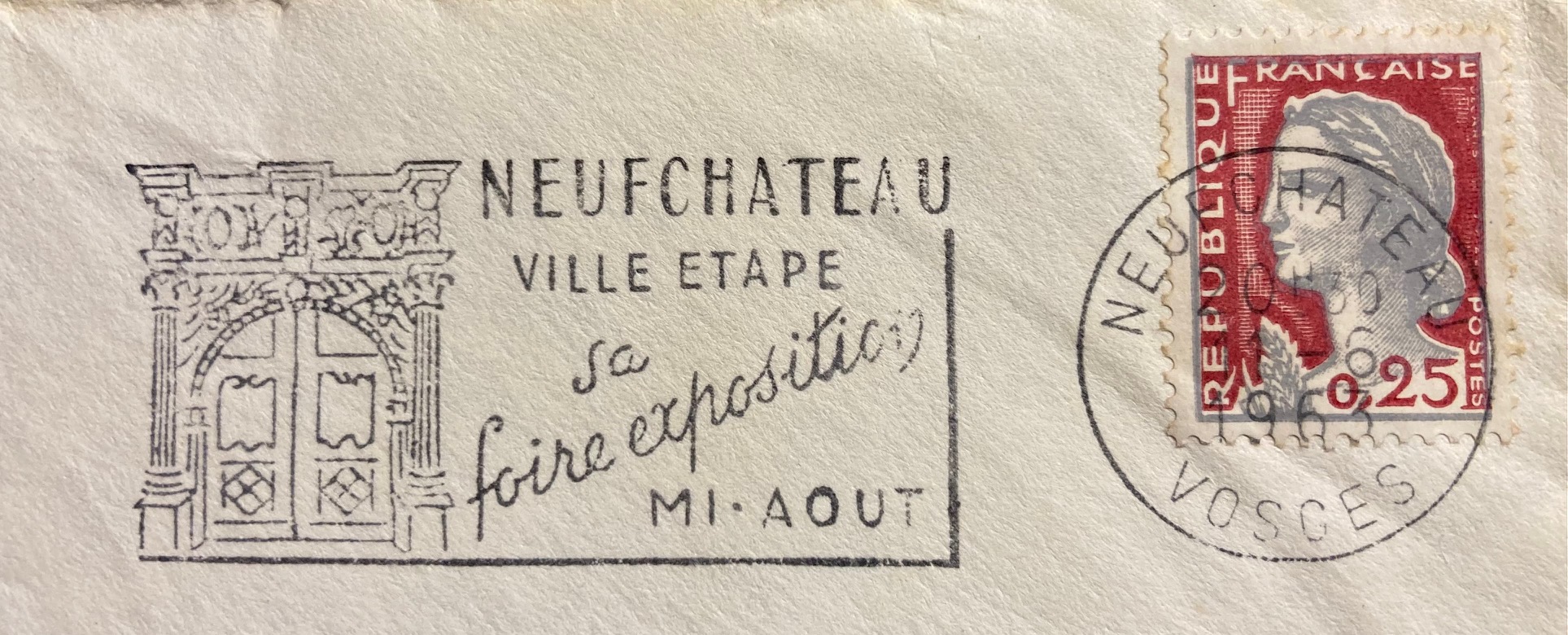
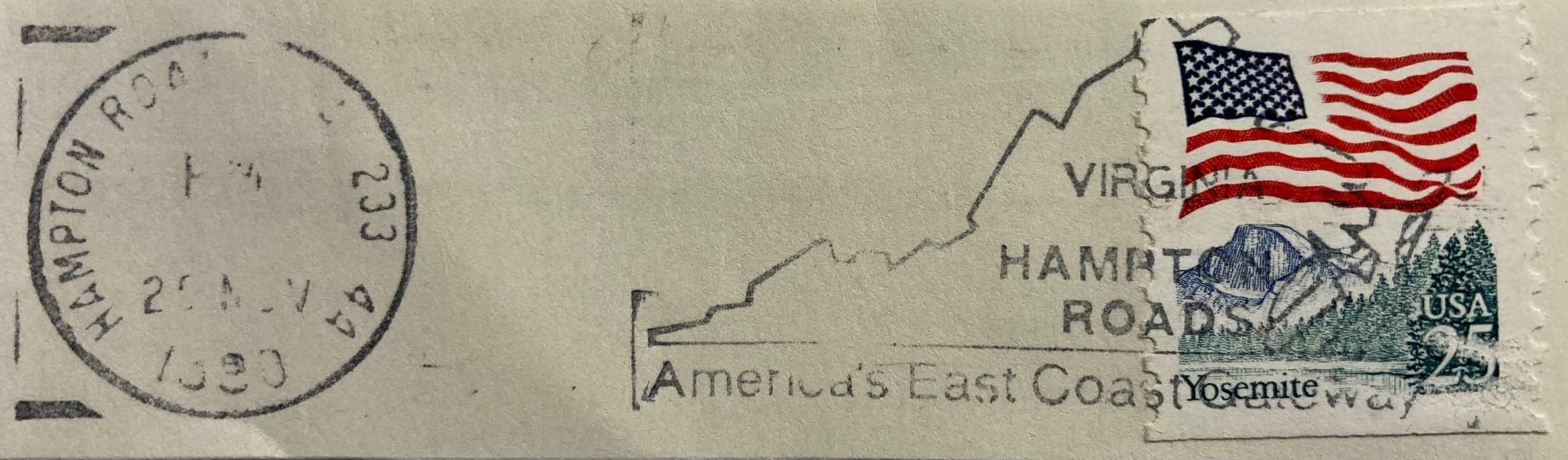
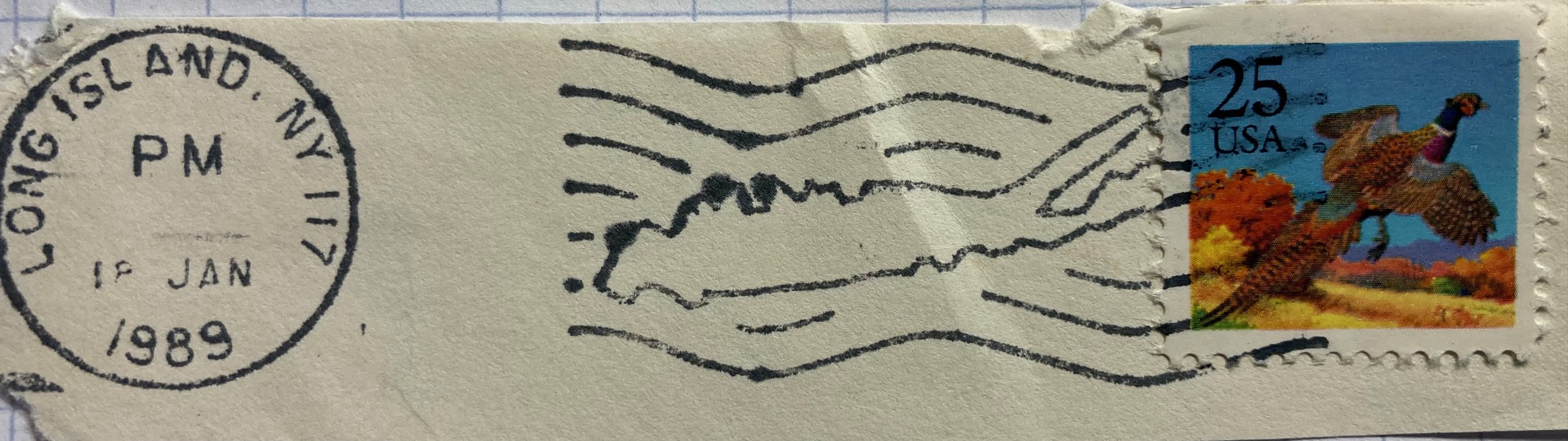
Others marks are fancier, depicting maps or places in the markings themselves. The examples below include a promotion for Hampton Roads in Virginia, and a stylized version of Long Island embedded in wavy cancellation lines. Most of the items I have are from the US, but you’ll find examples from around the world. The postal service in France has long created special markings to celebrate local and regional culture and history. This mark from the early 1960s celebrates an exhibition or trade fair in Neufchateau in northeastern France. For special markings like these, collectors will often save the entire envelope (in my case it was damaged, so I opted to clip out the marking and stamp). The stamp features Marianne, a legendary personification of the French republic who has appeared on definitive stamps there since the 1940s.
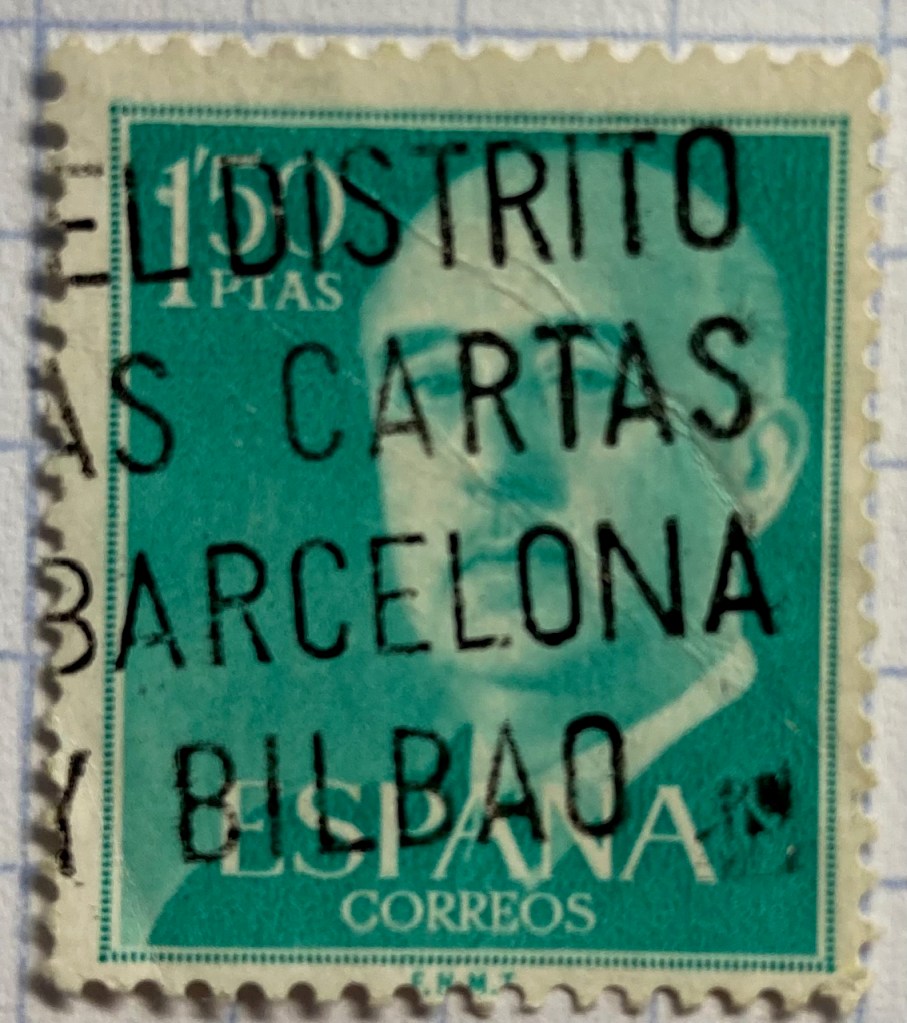
If you’ve acquired a bag of stamps you’ll get a mix that are on paper (clipped or torn from the envelope), or off paper (removed from the envelope by soaking in warm water, before the days of self adhesives). You often lose the message and provenance in these mixed bags, but are left with tantalizing clues, and funny quirks. The message on this 1970s Spanish stamp featuring long-time leader (aka dictator) Francisco Franco is unclear. He is shouting something about “districts” and “letters” in reference to the cities of Barcelona and Bilbao.

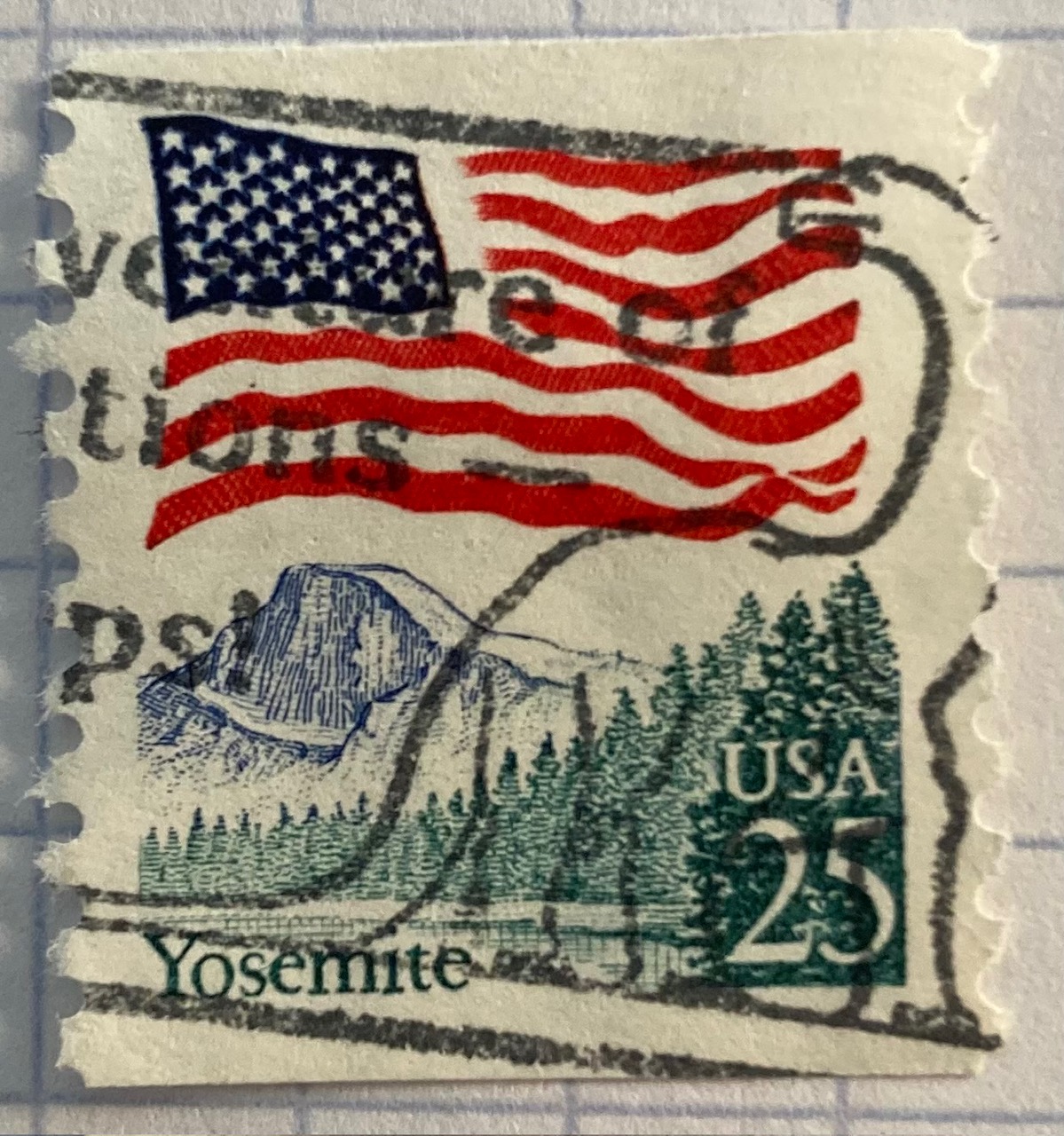
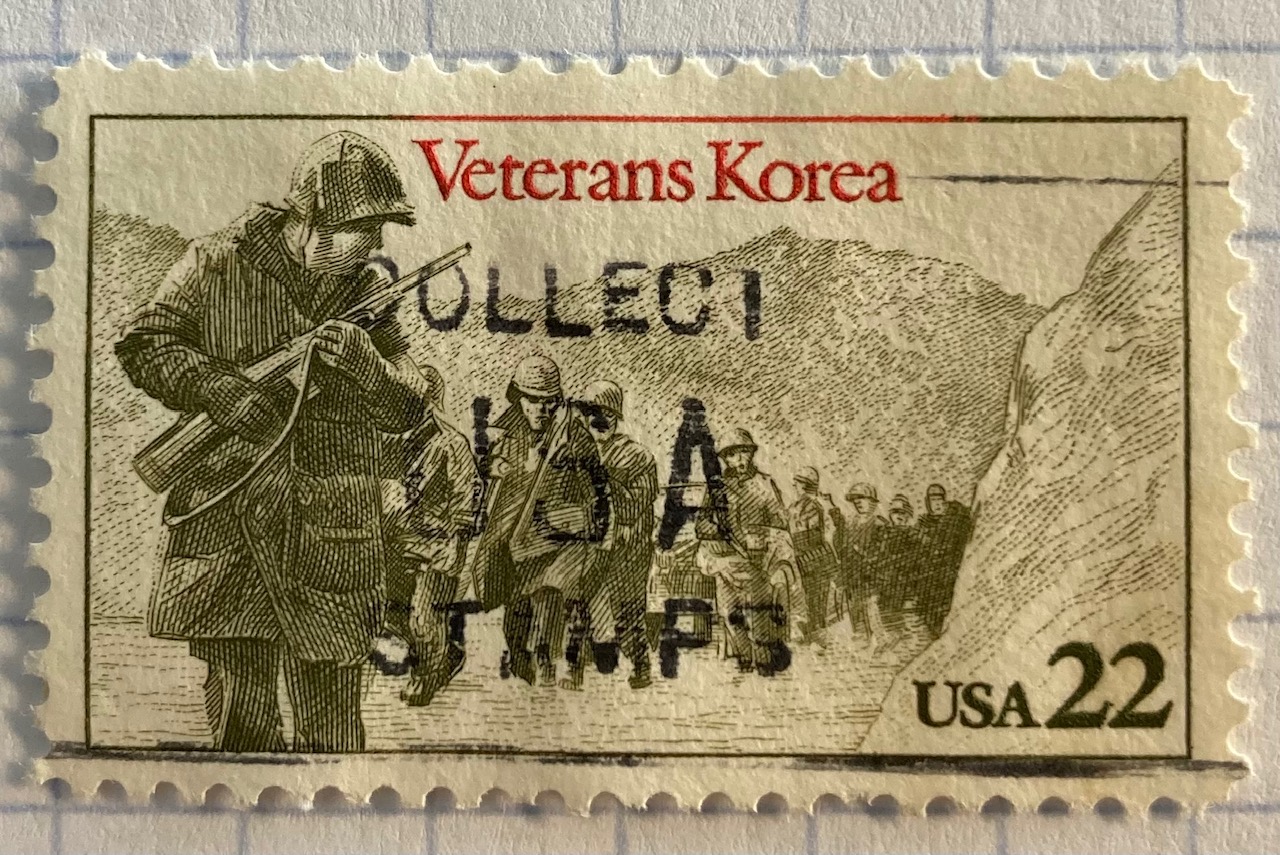
Did you know there were dinosaurs in Yosemite National Park? This brontosaurus was part of a larger marking that advertised the adventures of stamp collecting, which these US Korean War soldiers encourage you to do.
In Conclusion

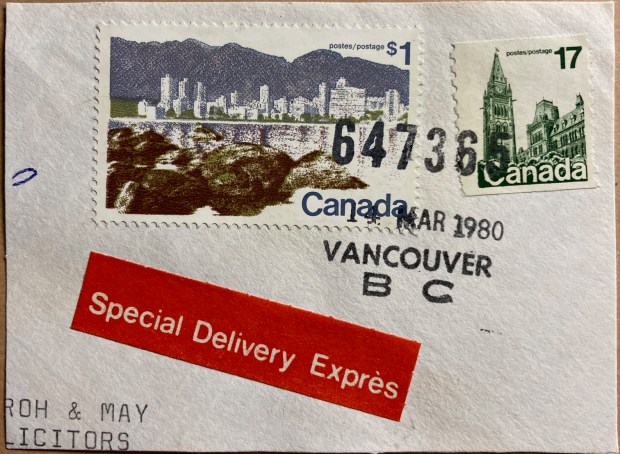
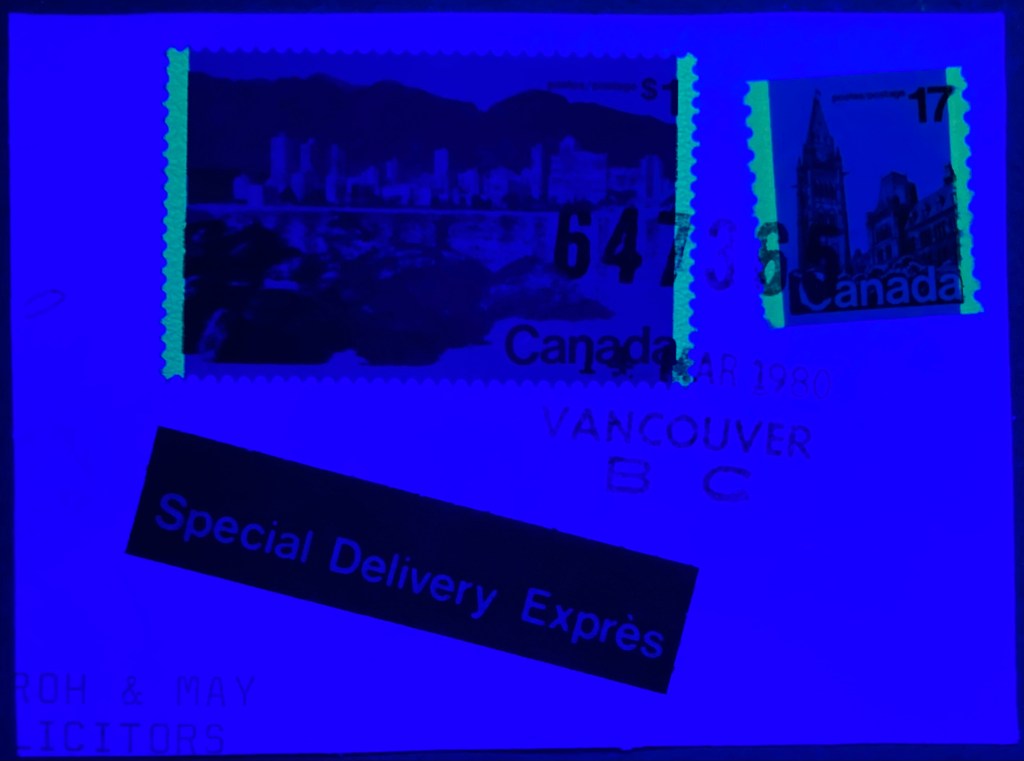
I hope you enjoyed this nerdy journey through the world of postmarks on stamps and their relation to geography. I’ll leave you with one final, strange fact that you may be unaware of. The lead image at the top of this post depicts a stamp of Vancouver’s skyline, that happened to be postmarked in Vancouver, Canada in March 1980. It’s always neat when you find these examples where the postmark and the stamp are linked. But did you know Vancouver glows in the dark? Countries began tagging stamps with fluorescence or phosphorescence in the mid 20th century, so machines could optically process mail. You can see them glow using special UV lamps – just be sure to wear protective eye wear (the bright yellow lines along the edges of the stamp are the tags).
iceland_placename

Place Names: Comparing Two Global Gazetteers

Gazetteers are directories of place names and locations, which are useful for:

  1. Identifying variations in place names
  2. Obtaining coordinates
  3. Locating a place within a hierarchy of places
  4. Generating lists of types of features

For example, if you’re working with data that’s associated with specific cities, mountains, or bodies of water, and you have the names of these features but not the coordinates or the country or state / province where they’re located, you can use a gazetteer to obtain all three. Or, if you want to create a map of a specific type of feature (i.e. populated places, ruins, mines) or want map labels for features (forests, bodies of water) you can extract and plot the gazetteer data in GIS.

In this post I’ll provide an overview of two major global gazetteers: the GEOnet Names Server and Geonames. Each one provides several different interfaces and services for exploring and accessing data which I’ll briefly mention, but I’ll focus on on the data files that you can download and what’s contained in them. I’ll conclude with a strategy for relating a small to medium place-based data file of your own to the gazetteer to obtain coordinates. If you have a file with hundreds or a few thousand records and were planning to get coordinates by eyeballing Google Maps and clicking one by one, try this instead.

NGA GNS

File Downloads | Documentation and code book

The US National Geospatial-Intelligence Agency (NGA) maintains a vast gazetteer with data for all of the countries in the world (almost) and provides it to the public via the GEOnet Names Server (GNS). The GNS gazetteer does NOT include features in the United States or any of its territories; the US Geological Survey maintains a separate system called the Geographic Names Information System (GNIS) whose structure and organization is different.

The GNS is updated on a weekly basis and is provided through a number of interfaces that include a map-based and a text-based search, and Web Mapping (WMS) and Web Feature (WFS) Services that allow you to display data in a GIS or a web map.

Data files are packaged on a country by country basis. Alternatively you can download one file that has the whole world in it, or an archive with separate files for each country. The data is stored in tab-delimited text files that include a header row (i.e. the column names). ZIP files for each country include a primary file that contains all the country’s features, and a series of files that contain a subset of the primary file based on feature type. So, if you wanted to work with just populated places or with hydrographic features you can work with the specific file instead of having to filter them out of the primary one.

Each record in the GNS represents a name for a feature, as opposed to a feature itself. Thus, if a feature is known by more than one name it will appear multiple times in the file. Each record has a unique feature identifier (UFI) and a unique name identifier (UNI) which are large integers. The UFI number is repeated in the data, while the UNI is unique. The GNS files contain a number of different columns containing several feature names (short names, long ones, with and without diacritics) and a name type column (NT) that indicates whether the record is for a an approved (N), or variant name (V). If you want a list of features without duplicates, you would need to create a subset of the records that only includes the approved name.

Features are classified into nine broad classes (FC), which in turn are subdivided into many different designations (DSG). The nine classes are: administrative region, populated place, vegetation, locality or area, undersea, roads and railroads, hypsographic (terrain), hydrographic (water), and spot (point-based features). Additional columns include codes designating the size of a populated place (PC) and relative importance of the feature (DISPLAY) which is useful when mapping data at varying scales. The GNS does not contain information on actual population or elevation (this was included in the past but is no longer available).

The GNS includes a few geographic references that indicate where the feature is located. There is a global region code (RC) in the first column, a primary country code (cc1) and an administrative division (state or province) code for the primary country, and a secondary country code (cc2). Geographic features like rivers, seas, mountains, and forests may span the boundary of more than one country, so the cc1 and cc2 columns indicate this. Data in these fields may be stored as a comma-separated list or array with the different codes. The GNS uses two-letter FIPS 10-4 country codes created by the US government.

Country codes in the GNS

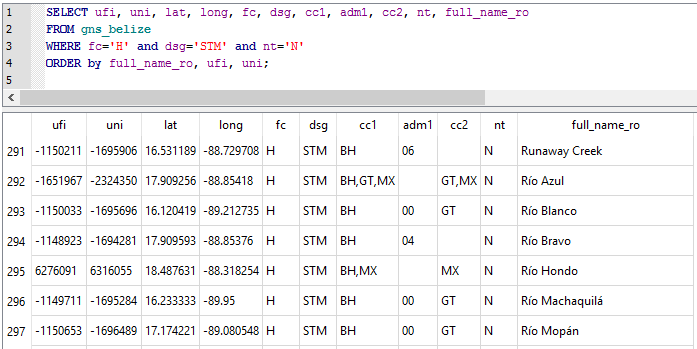
This SQL query illustrates how country and admin1 codes are stored in the GNS, and how some features (streams in this case) span several countries.

Lastly, longitude and latitude coordinates are provided in separate fields in two formats: decimal degrees (needed for plotting and mapping) and degrees-minutes-seconds. The coordinates are in the WGS 84 CRS (EPSG 4326).

Geonames

File Downloads | Documentation and code book

Geonames is the Wikipedia or OpenStreetMap of gazetteers. It’s a collaborative, crowd-sourced project. Many users may contribute a few locations or make a correction or two, but by and large most of the data comes from public or government sources that is loaded into Geonames en masse and subsequently modified. Geonames provides a text and map-based search, and an API that let’s scripters and programmers directly access the data.

Data files are packaged country by country, or globally by certain types (i.e. all countries or the largest cities). The data is stored in tab-delimited text files without a header row, so you need to consult the documentation to identify the columns. All data for each country is packaged in a single file.

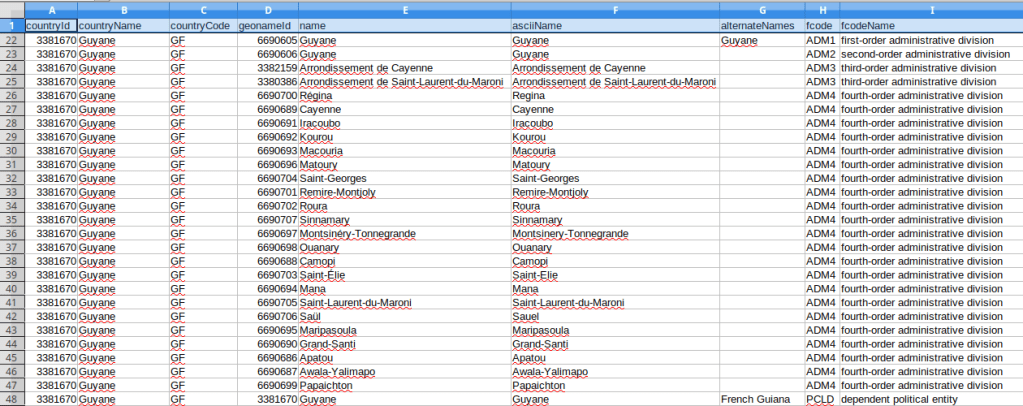
Unlike the GNS, each Geonames record represents a specific feature. There is a conventional name (name) and a variant that uses plain ascii characters (asciiname). Some variant names are included in a single list / array column called alternatenames; to get a full list of variants and spellings in different languages you would download a separate alternate names file that you could link to this one. Each feature is assigned a geonameid, which is simply a large unique integer.

Features are divided into the same nine classes that are used in the GNS, and the subdivisions are the same as well. Documentation for the classes and subdivisions is provided. Population and elevation data is provided when available and relevant, but there’s no information on timeliness or source in the data file (but you can view the full edit history for a record in the online interface).

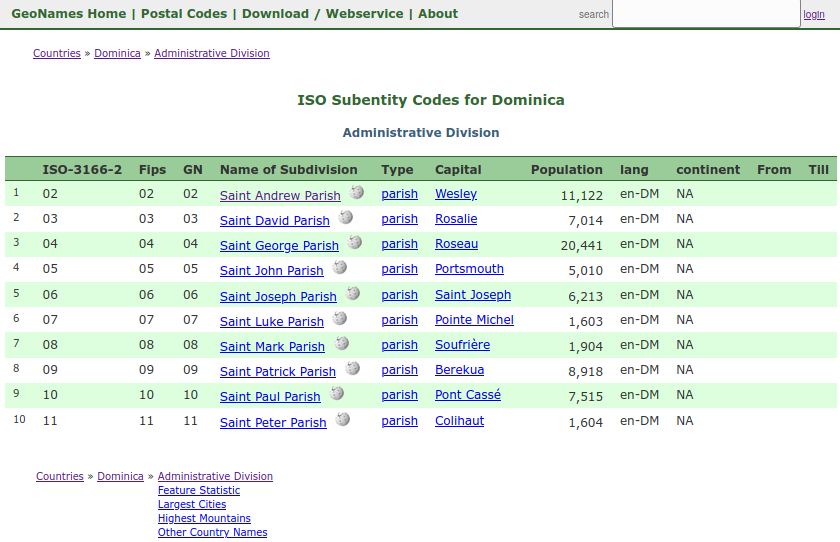
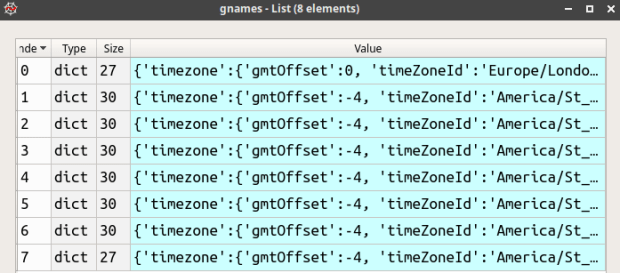
Geonames goes to great lengths to provide the geographic framework or hierarchy for each feature, so you can get instant geographic context. They use two-letter ISO country codes to designate countries (country_code), a list of alternate or secondary countries (cc2), and for the primary country up to four different levels of administrative divisions (i.e. state / province, county, municipality, etc). There’s also a field that indicates what timezone each feature is in.

There is one set of longitude and latitude coordinates in decimal degrees in the WGS84 CRS.

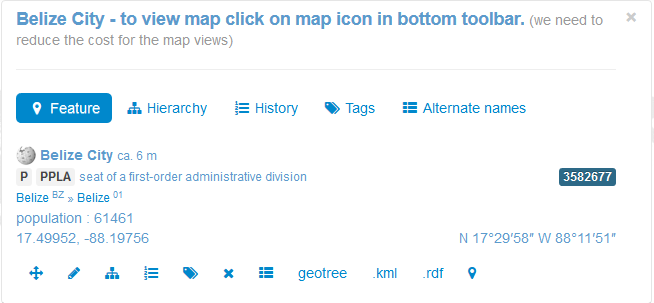
Geonames Belize City

Geonames search result for Belize City, illustrating options and available data.

Summary Comparison

To compare the different files I downloaded data for Belize, since it has a small number of records. The GNS file had 2,801 records for names, but if you look at unique features the record count was 2,180. The Geonames file for Belize has a comparable number of 2,309.

Commonalities

  • Free and publicly available
  • Tab-delimited text in country-based files
  • Longitude and latitude coordinates in decimal degrees in WGS84
  • Same feature classification system with nine classes and multiple sub-classes

GNS

  • A single, official government source
  • A file of feature names: must filter out variants to get unique feature records
  • File comes with column header
  • Files are divided into sub-files for feature classes
  • Uses FIPS codes for countries
  • Useful fields for ranking features for mapping
  • Limited data on geographic hierarchy
  • No data on population or elevation
  • Lacks data for the United States and territories (obtainable via the USGS GNIS)

Geonames

  • Collaborative project with data from many sources
  • A file of features, variant names included in separate column
  • Additional alternate names and spellings in most languages available in separate files
  • File lacks column header
  • Uses ISO codes for countries
  • Extensive information on geographic hierarchy
  • Has population, elevation, and timezone for certain features
  • No ranking columns for map display

Gazetteer Caveats

1. It’s important to recognize that each source uses different codes for classifying countries: the GNS uses FIPS and Geonames uses ISO. While they appear similar (two-letter abbreviations) they are NOT the same: The FIPS code for Belize is BH and the ISO Code if BZ; in the ISO system BH is for Bahrain while the FIPS system doesn’t use BZ as a code. The CIA World Factbook includes a table comparing different country code systems. The GNS will convert to ISO at some uncertain date in the future.

2. Gazetteer data must be imported using UTF-8 encoding to preserve all the characters from the various alphabets.

3. Each feature in a gazetteer will have longitude and latitude coordinates that represent the geographic center of a feature. That means that a large areal feature like a country, a linear feature like a road, and a small point feature like a monument will have one coordinate pair. The coordinates for the monument will be pretty precise, while the set for the road and country are broad generalizations. Long linear features like roads and rivers may appear in the datasets several times as distinct feature records at different points. While it’s possible to get bounding box coordinates from Geonames, this data is not included in the downloadable country files.

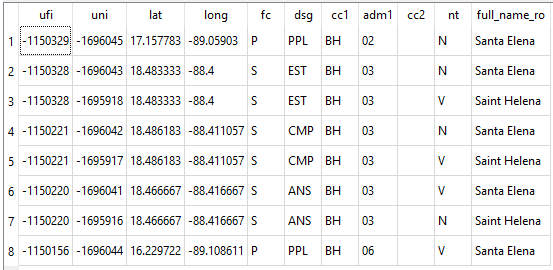
4. A place name may appear multiple times in a gazetteer because names are not unique. Several different places of the same type may have the same name, and several features of different types may have the same name. For example, the Geonames file for Belize has four places name Santa Elena; two are populated places in different parts of the country while the other two are spot features (a camp and an estate) that are located near each of the populated places. The GNS file has even more records for this place, some with the approved name Santa Elena and others with the variant Saint Helena.

GNS Names and Variants

GNS records for Santa Elena, Belize. Notice the UFI is duplicated for features that have multiple names while the UNI is unique. The NT field indicates approved names (N) versus other types like variants (V). Records are for a mix of populated places (P, PPL) and spot (S) types of various kinds (ancient site, campground, and estate).

For all these reasons, it rarely makes sense to use the files in their entirety for obtaining names and coordinates or plotting places. You’ll want to extract data just for the types of features that you need. If you’re trying to match a list of place names to the gazetteer you’ll need to insure that you’re matching the right name to the right place. You can use the feature classes and the administrative divisions of the country to narrow down the location, and when in doubt use the gazetteer map interfaces to locate a specific place.

Matching Your Own Data to a Gazetteer

Winnow down the gazetteer file to just the features you need. Make sure that all the place names in your own data file are standardized so you don’t have variant spellings for the same place. In your data add a column for a unique identifier at the beginning of the sheet. Locate each place in your file in the gazetteer, then copy the unique ID from that file into your sheet. Then, if you’re using a spreadsheet you can use the VLOOKUP formula to use the ID from your sheet to pull related data from the gazetteer sheet (the longitude and latitude coordinates, codes for the administrative divisions, etc). This saves you a lot of copying and pasting. Similarly, if you were using a relational database you can write a JOIN statement to tie the two tables together using the ID.

This approach saves you the time of manually clicking on Google Maps or OSM to look up coordinates for a place and transcribing them, and you get the added benefit of grabbing any extra useful information the gazetteer provides. If you haven’t started the process of gathering your own data, start with the gazetteer file: winnow it down and append your own data to it as your research progresses.

But what if you had tons of coordinates that you need to retrieve? Because of the ambiguity in place names using a VLOOKUP or JOIN based on the name will be imprecise, because there may be more than one place with the same name and you’ll have no way of knowing if you selected the right one. You could modify your own data and the data in the gazetteer by concatenating administrative codes to the place name (i.e. St. Elena, 02) to make the name more precise and increase the chances of an accurate join. This approach requires you to be familiar with the administrative subdivisions in the areas you’re researching.

If you were trying to identify coordinates for tens of thousands of towns, cities, and larger administrative divisions you could try using a geocoder instead of a gazetteer. Geocoders are designed primarily for obtaining coordinates for addresses, but if an exact match can’t be found many will return coordinates for the smallest possible area that’s part of the address. If you provided a list of cities that also include a state / province and country, you could obtain the coordinates for just the city.

A final alternative where you can get a wider range of features in a geospatial format in bulk is the OpenStreetMap. I’ll return to this in a future post, but there’s an excellent OSM – QGIS tutorial that can help get you started.

Interested in learning more? If you’re in the spatial sciences or digital humanities check out this book: Placing Names: Enriching and Integrating Gazetteers.